

I have a studio practice — drawing, painting, making things with my hands — and for most of my life I thought of that work as separate from writing. One was visual, one was verbal. One happened in silence, one in language. They felt like different modes.
What I’ve come to understand is that both are air practices. Both require the same fundamental movement: taking something invisible — an impression, a perception, an idea not yet formed — and giving it shape in the world. That translation from the internal and wordless into the external and communicable is air’s essential work. It’s the same element whether the medium is paint or language, line or sentence.
Air is the most invisible of the four elements and in some ways the most intimate — you carry it with you constantly in the form of breath, the most immediate proof that you are alive. We take it for granted precisely because it’s always there. But paying attention to it — to breath, to thought, to the quality of mental space you inhabit — is one of the most powerful things a spiritual practice can do.
The sacred status of air appears in virtually every human spiritual tradition, and in many of them it’s not just an element but a living, divine force.
In classical Western esoteric tradition — the four-element framework running through alchemy, astrology, tarot, and modern pagan practice — air is the element of the east, of spring, of dawn, of the mind as it opens to new possibilities. It corresponds to the sword as a symbol, to the suit of Swords in tarot, to thought, communication, and the swift, cutting clarity of honest perception.
In Hindu and yogic tradition, air corresponds to vayu — both an element and a deity. Vayu is the god of wind and breath, considered the vital force that animates living beings, the carrier of prana (life energy) through the body and through the world. The pranayama practices of yoga — intentional breath control — are among the oldest and most sophisticated air element practices in existence, developed over thousands of years as a direct method of working with air as a spiritual force. The relationship between breath and consciousness in yogic understanding is not metaphorical: controlling the breath genuinely alters the state of the mind.
In Greek tradition, Hermes — messenger of the gods, patron of communication, language, travelers, and the crossing of boundaries — is the deity most aligned with air energy. Swift, clever, comfortable in liminal spaces, carrying words between realms — Hermes governs precisely what air governs: the movement of thought and communication between beings and between worlds. In Norse tradition, Odin’s association with wind and with the runes — the sacred alphabet used for divination and magic — places the all-father in air’s domain as well. The runes arrived to Odin through sacrifice and prolonged endurance, a reminder that air’s gifts of clarity and communication are not always easy to receive.
In Chinese five-element theory, the closest equivalent to Western air is wood (木, mù) — the element of spring, growth, expansion, and the upward movement of new life. Wind in Chinese medicine is the carrier of both vitality and illness, the force that animates and the force that disrupts. The lungs and large intestine are the organs associated with the metal element, which in Chinese theory carries some of air’s Western qualities — the breath, the letting go, the clarity that comes from releasing what is no longer needed.
In Celtic and Northern European seasonal tradition, air’s energy is most concentrated at Imbolc and the spring equinox — the time when the world opens after winter’s contraction, when the first hints of movement return to a landscape that has been still.
Air isn’t a single quality — it’s a domain. Here’s what falls within it.
Thought and the mind. Air governs not just analytical thinking but the full range of mental life — perception, imagination, intuition (where it meets water), the ability to observe your own thoughts without being consumed by them. Air at its best is a clear sky: the mind open, spacious, able to see far and hold complexity without forcing it into premature resolution. The spiritual work of air is learning to inhabit the mind without being trapped by it — to think clearly without over-identifying with thought as the totality of experience.
Communication and language. Air is the element of speech, of writing, of all the ways we translate internal experience into shared meaning. The throat chakra’s strong air association is not incidental — the voice carries breath into the world in the form of words, making the invisible visible, the private public. Working with air spiritually often involves a deepening relationship with language: saying true things more precisely, using speech consciously rather than reflexively, and developing the courage to communicate what is actually present rather than what is expected.
Connection and exchange. Air moves between things — between people, between places, between inner and outer worlds. It is the element of relationship in its communicative dimension: the exchange of ideas, the meeting of minds, the invisible thread of understanding that forms when two people genuinely communicate. Community, conversation, the circulation of ideas through a culture — these are air in its social expression.
Freedom and movement. Air cannot be held or contained for long. Its energy is inherently free-moving, resistant to being fixed or pinned down. Spiritually, air governs the quality of mental and spiritual freedom — the ability to question what is assumed, to move between perspectives, to not be confined by any single viewpoint or identity. The shadow of this, as we’ll come to, is the difficulty air has with commitment and depth.
Clarity and perception. Of all the elements, air is the one most associated with seeing things as they actually are rather than as we wish or fear them to be. The sharp, clear quality of air — the way a cold wind makes the world suddenly vivid and distinct — is the quality it brings to perception. This is why the Swords suit in tarot, despite its reputation for difficulty, is fundamentally about truth: the discomfort of Swords cards is almost always the discomfort of seeing something clearly that has been obscured.
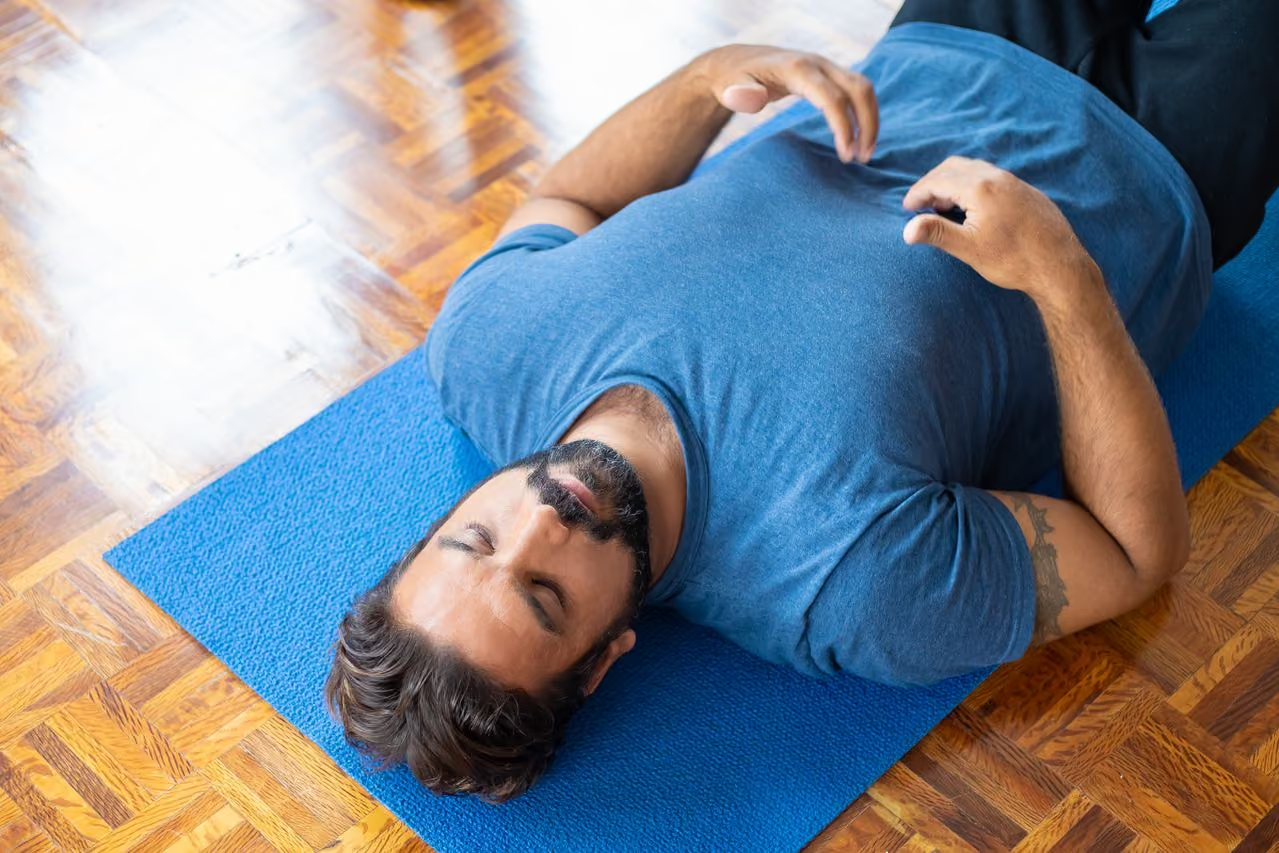
Air’s primary chakra association in many traditions is Anahata — the heart chakra, the fourth chakra, located at the center of the chest. This surprises some people who expect air to live primarily in the head alongside thought and communication.
The heart chakra’s air association makes sense when you understand what the heart chakra actually governs. Anahata doesn’t just govern romantic love — it governs the quality of open, spacious awareness that is the prerequisite for genuine connection of any kind. The Sanskrit name means “unstruck sound” — the vibration that exists before and beneath all manifest sound, the silence from which music comes. That’s an air quality: the open space in which things can move freely.
The breath is literally centered in the chest — the expansion and contraction of the lungs governs the rhythm of air in the body. Breathwork practices that work with the heart chakra draw directly on the air-heart connection: opening the chest, expanding the breath, releasing the compression that grief, fear, and sustained stress create in the thoracic space.
The throat chakra (Vishuddha) carries air’s secondary association — governing the voice, honest speech, and the translation of inner knowing into outward expression. Air moves from the heart (where it is felt as spacious awareness and connection) through the throat (where it becomes language and sound) into the world. The full air circuit runs this path: open awareness → honest perception → true speech.
In tarot, air’s suit is Swords — the cards of thought, communication, conflict, and the kind of clarity that sometimes arrives as a cut rather than a comfort. The Swords suit has a reputation for difficulty, which is worth examining: the difficulty of Swords is almost always the difficulty of truth. These cards don’t predict bad outcomes so much as they demand honest reckoning with what is actually present.
The Ace of Swords is pure mental clarity — the breakthrough thought, the moment of sudden and complete understanding. The Three of Swords is grief made visible, the pain that comes when truth is finally acknowledged. The Eight of Swords is the self-imposed mental prison — the cage that is, on close examination, unlocked. The Queen of Swords is air mastered: clear perception, hard-won wisdom, the ability to see and say what is true without cruelty and without softening it into something less honest.
The air zodiac signs carry these qualities in astrology. Gemini, ruled by Mercury, is air as curiosity and the love of ideas — the sign of the twins, comfortable holding contradictions, endlessly interested in how things connect. Libra, ruled by Venus, is air as the desire for balance and beautiful thought — the scales, always weighing, seeking the most just and harmonious arrangement of what is. Aquarius, ruled by Saturn and Uranus, is air as vision and the long view — the water bearer (who carries air in disguise) seeing patterns and possibilities beyond what is immediately apparent.
Conscious breathwork. The most immediate air practice requires nothing external. Sit comfortably. Close your eyes. Bring your full attention to the breath — the sensation of air entering the nostrils, expanding the chest and belly, and releasing. Don’t control it initially; simply observe. After several minutes, begin to lengthen the exhale: breathe in for four counts, out for six or eight. This activates the parasympathetic nervous system — the body’s rest-and-digest response — and creates the quality of mental spaciousness that is air’s gift. The breath is always available, always an entry point into air’s domain.
Journaling and externalizing thought. Writing — particularly free writing without agenda or editing — is an air practice that moves the invisible into the visible. Taking what is swirling in the mind and committing it to language on a page creates the kind of clarity that internal rumination rarely produces on its own. The act of articulation — of finding the precise word for a precise experience — is air work at its most useful. Write without planning what you’ll say. Let the pen follow the thought rather than the thought following the pen.
Spending time in wind. Go outside on a windy day and simply be in it. Feel the air moving against your skin, through your hair, pressing against you from a direction you have to orient to. Wind is air made tangible — the invisible element briefly perceptible. Many traditions consider wind a carrier of messages and presences; at minimum, it is a direct sensory encounter with the element that usually passes unnoticed.
Working with air element crystals. Clear quartz, amethyst, lapis lazuli, sodalite, and blue lace agate are among the most accessible air element crystals. Amethyst quiets the mental chatter that keeps air from being clear; lapis lazuli sharpens perception and supports honest speech; blue lace agate is particularly gentle for throat chakra and communication work. Hold them during meditation, journaling, or any practice that requires mental clarity and honest expression.
Pranayama and breath-centered movement. Yoga practices oriented toward the breath — pranayama specifically, but also any movement practice where breath leads — cultivate air element awareness in the body. The ancient yogic understanding that breath and consciousness are directly linked means that working with the breath is working with the mind, which is working with air. Even five minutes of intentional breathwork before meditation or creative work shifts the quality of what follows.
High places and open sky. Mountains, hilltops, open fields, anywhere the sky is wide and the horizon is visible — these are air environments. The quality of mental clarity that comes from being somewhere high and open is an air quality. Many practitioners find that creative and spiritual breakthroughs arrive in these environments, which makes sense: air energy supports the kind of expansive, unconstrained thinking that enclosed environments and busy schedules don’t easily allow.
Air energy becomes shadow when it loses its relationship to the other elements.
Air without earth becomes ungrounded — thought without body, ideas without implementation, the brilliant mind that never quite lands anywhere and builds nothing lasting.
Air without water becomes cold — clarity without compassion, intellect without feeling, the analysis that is technically correct and entirely missing the point of what it means to be human.
Air without fire becomes aimless — perception without passion, movement without direction, the mind that sees everything clearly and commits to nothing.
The spiritual practice of air is not just the development of mental clarity but the willingness to use it in service of something — to let the clear perception lead somewhere, to speak what is seen honestly, and to remain curious rather than certain. Air that moves carries seeds. Air that stagnates carries nothing. The invitation of this element is to keep moving, keep questioning, and keep the mind spacious enough that something new can always arrive.
Open a window. Sit near it.
Feel the air moving into the room — the slight change in temperature, the barely perceptible movement against your skin. Take three slow breaths and let your awareness ride outward on the exhale rather than turning inward.
Ask yourself: what am I not saying? Not to anyone in particular — just in general. What perception have you been carrying privately that hasn’t found language yet?
You don’t need to say it aloud or write it down, though you can. Just let it become more legible to yourself. Air’s gift is clarity — the ability to see what is present more precisely than the busy mind usually allows.
Stay as long as you want. When you close the window, notice whether the quality of the room feels any different. Air moves through and leaves things changed in ways that are hard to name but easy to feel.
Don’t forget to follow Kellee for the latest news and music:
add soundcloud, IG





Sign up to get our latest news and stay connected.
Thank you! Your submission has been received!
Oops! Something went wrong while submitting the form





.avif)

.avif)
