
I have a lot of plants. More than is probably reasonable for the square footage I occupy. Succulents on the windowsill, trailing pothos in the corners, a fiddle leaf fig that has survived several moves and my occasional forgetfulness with the watering can. Taking care of them — the repotting, the pruning, the checking of soil moisture, the rotating toward light — is one of the most grounding things I do.
I didn’t always think of it as a spiritual practice. But the more I’ve learned about earth as a spiritual element, the more I’ve come to see that tending to growing things — to soil, to roots, to the slow patient process of something alive in your care — is precisely the kind of work the earth element governs. Not dramatic. Not transcendent. Quietly, persistently real.
Earth is the element that gets the least attention in spiritual conversation, which is interesting because it’s the most immediately accessible. You’re standing on it right now. Your body is made of it. Everything you eat came from it. Of all the elements, earth is the one we literally cannot live without — and yet in spiritual practice it’s often treated as the less interesting foundation that the other elements get to stand on.
It isn’t a foundation to step past. It’s the whole point of the practice having somewhere to land.
The recognition of earth as a sacred element appears in virtually every human spiritual tradition, which says something important: this isn’t a cultural invention. It’s a consistent human response to a consistent physical reality.
In classical Western esoteric tradition — the four-element framework that runs through alchemy, astrology, tarot, and modern pagan practice — earth is the element of the north, of winter, of midnight, of the physical plane where spirit becomes matter. It corresponds to the pentacle as a symbol, to the suit of Pentacles in tarot, to the body, to money, to the slow building of lasting things.
In Hindu cosmology and Ayurveda, earth (prithvi) is one of five classical elements (alongside water, fire, air, and ether/space). It corresponds to the sense of smell, to the qualities of heaviness, stability, and cohesion, and to the kapha dosha — the constitutional type characterized by groundedness, endurance, and a tendency toward physical density. Earth people, in Ayurvedic understanding, are the ones who finish what they start, who build steadily, who are there when things get hard.
In Chinese five-element theory, earth (土, tǔ) sits at the center rather than in a directional position — it is the mediating element through which all others move. The spleen and stomach are its organs; yellow is its color; late summer is its season. Earth in this system is associated with digestion in the broadest sense — not just the processing of food but the processing of experience, the ability to take in what nourishes and release what doesn’t.
In indigenous traditions globally, the earth itself — not earth as an abstract element but the literal ground, the specific land, the particular soil of a place — is understood as a living being deserving of relationship, reciprocity, and care. The Lakota concept of Mitákuye Oyásʼiŋ — all are related — includes the earth not as a resource or a backdrop but as a relative. This understanding runs counter to the Western tendency to treat the earth element as metaphor; in many indigenous frameworks, the metaphor is the less complete version of the truth.
In the Wheel of the Year and Celtic-influenced seasonal practice, earth’s energy is most concentrated at Samhain and the winter months — the time when the above-ground world goes quiet and energy moves into roots, into depth, into the dark underground work that makes spring possible.
Earth isn’t a single quality — it’s a domain. Here’s what falls within it.
The physical body. The most intimate earth is the one you inhabit. Earth spirituality begins with the recognition that your body is not a vehicle for your soul to travel around in — it is the form your soul has taken in this life. Treating the body as spiritual practice means attending to it — nourishing it, resting it, moving it, listening to what it communicates — not as a prerequisite for spiritual practice but as an expression of it.
Material reality and abundance. Earth governs money, resources, home, work, and the physical conditions of daily life. This is often where modern spiritual practice goes wrong — treating material concerns as spiritually inferior to inner or transcendent work. Earth-centered spirituality insists that there is nothing unspiritual about wanting to live in a safe home, to have enough money, to build something lasting with your hands and your time. Abundance is earth’s natural expression when its energy is healthy and flowing.
Patience and endurance. Earth moves slowly. Stone forms over millions of years. Trees grow toward the light one ring at a time. Soil is built through the accumulation of countless small decompositions. Earth’s spiritual teaching is that the things worth building take longer than we want them to and require more sustained attention than urgency allows. The capacity to persist — to keep showing up, to keep doing the small unglamorous work — is an earth quality, and it’s one that most modern practice undervalues.
Stability and foundation. Nothing built on unstable ground lasts. Earth’s gift to spiritual practice is the insistence that foundation matters — that the grounded, embodied, practically stable life is not separate from the spiritually rich life but is its prerequisite. You cannot sustain deep spiritual work from a place of material chaos, physical depletion, or chronic ungroundedness.
The natural world. Earth is the element most directly connected to the living systems of the planet — the forests, the soil ecosystems, the slow cycling of nutrients through living and dying organisms. A spiritual relationship with earth necessarily includes a relationship with the natural world: not as scenery but as community, as kin, as the web of life that includes and sustains human existence.
In the chakra system, earth’s primary home is Muladhara — the root chakra, at the base of the spine. The root governs exactly what earth governs: physical safety, foundational stability, the sense of belonging in a body on a planet, the most basic layer of trust that the ground will hold.
A depleted or blocked root chakra is recognizable as a kind of chronic ungroundedness — anxiety that lives in the body as a persistent low hum, financial fear that doesn’t respond proportionally to actual circumstances, difficulty feeling at home anywhere, a sense of being fundamentally unsafe despite the absence of immediate threat. These are earth-depletion symptoms.
An overactivated root — earth energy running hot or rigid — shows differently: hoarding, excessive materialism, an inability to release or let go of things, people, or patterns that have become stagnant. Earth without flow becomes stuck.
Healthy earth energy in the root chakra feels like a quality of settled presence — the sense of being genuinely here, in this body, on this ground, without needing circumstances to be different from what they are in order to feel okay. That quality of basic okayness is earth’s most fundamental gift.
Working with earth-element practices — grounding meditations, time in nature, certain crystals, the physical act of gardening or cooking — is among the most direct ways to support the root chakra.
In the tarot, earth’s suit is Pentacles — the cards of material life, money, work, the body, and the long patient process of building something real. The Pentacles suit is sometimes called boring, which misses what it’s actually doing: asking whether your values are reflected in how you actually spend your time and money. That’s one of the most searching questions available in any reading.
The Ace of Pentacles is the seed of material opportunity — something real beginning. The Nine of Pentacles is the flowering of sustained effort — self-sufficiency and abundance arrived at through patience. The Ten of Pentacles is the legacy — what gets passed forward, what endures. The whole suit tells the story of earth: slow, cumulative, rooted in the real.
The earth zodiac signs — Taurus, Virgo, Capricorn — carry this energy in astrology. Taurus, ruled by Venus, brings earth’s sensory pleasure and abundance. Virgo, ruled by Mercury, brings earth’s attention to detail and commitment to useful work. Capricorn, ruled by Saturn, brings earth’s long game — the willingness to build slowly toward something that lasts.
As a Virgo, I feel that connection personally. Earth energy is in my nature, and I see it come up all the time in the precision and care I put into walking my path in life, and the belief that how you do something matters as much as what you do.
Barefoot grounding (earthing). Walking barefoot on natural surfaces — grass, soil, sand, stone — creates direct electrical contact between your body and the earth. Research on earthing suggests measurable physiological effects including reduced inflammation and cortisol, improved sleep, and nervous system regulation. Spiritually, it is the most direct form of earth connection available: your body literally touching the body of the earth, energy moving between them.
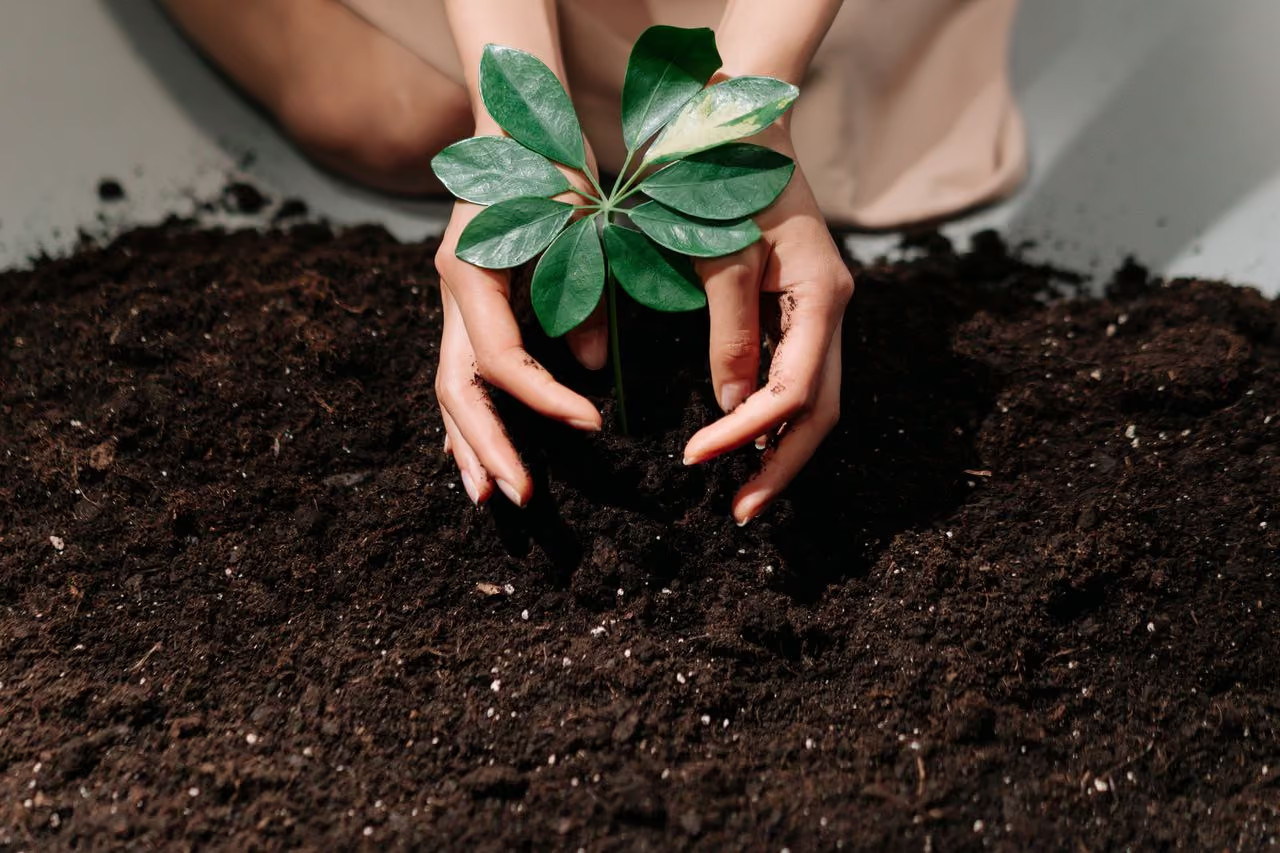
Gardening and tending. Putting your hands in soil — growing food, tending plants, composting, even simply repotting a houseplant — is an earth practice in the most literal sense. The attention required, the relationship with living things, the patience of watching growth happen on its own timeline rather than yours — all of it teaches what earth teaches.
Grounding meditation. Sit or stand with your feet flat on the floor. Close your eyes. Bring your attention to the soles of your feet — feel their contact with the surface beneath them. Visualize roots extending from the base of your spine and the soles of your feet, moving down through the floor, through the foundation, through layers of earth and stone, reaching into the deep, stable core of the planet. Let your weight drop into those roots. Breathe. Stay as long as you need.
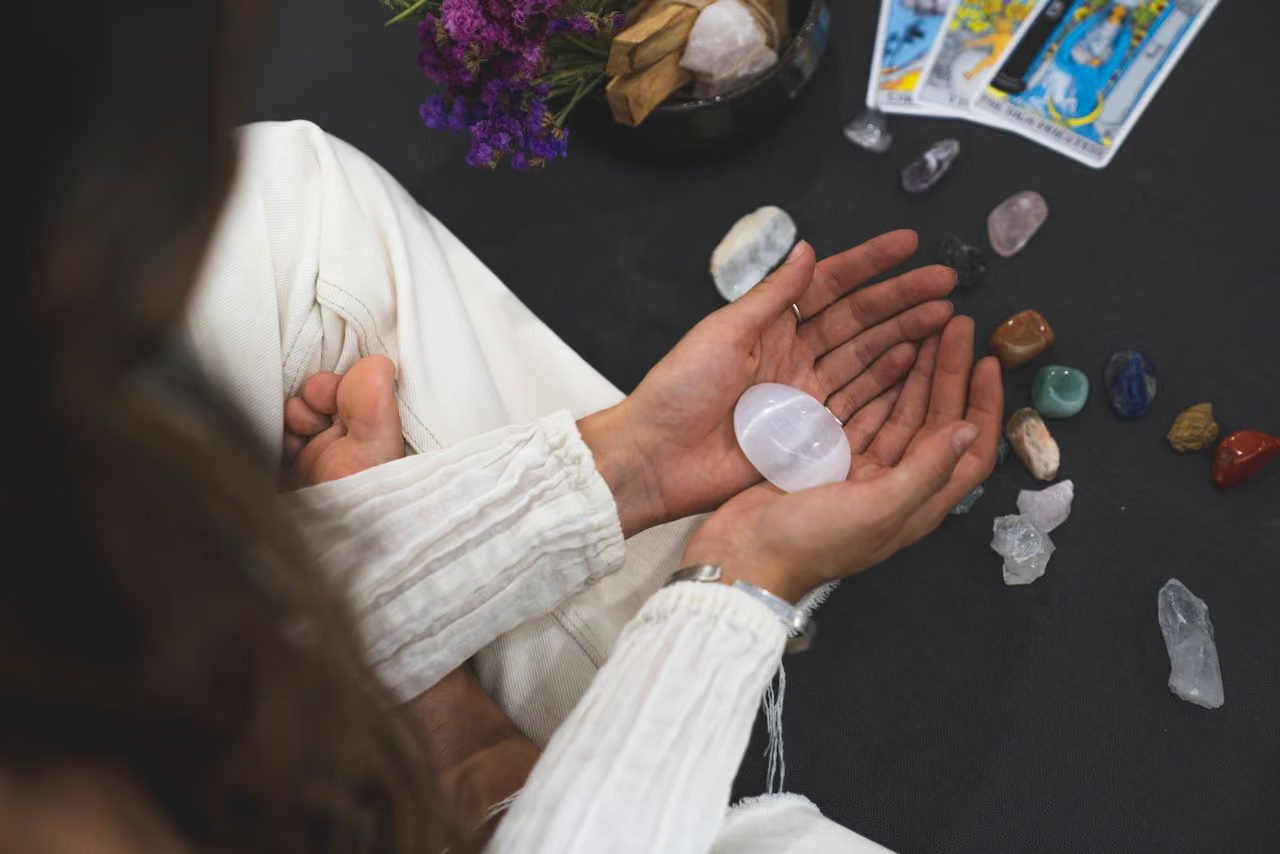
Working with earth-element crystals. Black tourmaline, tiger’s eye, obsidian, hematite, jasper, and malachite are among the most grounding and earth-aligned stones in the crystal collection. Hold them during meditation, carry them in your pocket, or place them at your feet during grounding practice. Each brings a slightly different quality of earth energy — black tourmaline for protection and root activation, tiger’s eye for grounded confidence, malachite for abundance and natural world connection.
Eating with attention. Food is earth transformed — the sunlight and soil and water of a specific place made into nourishment for your body. Eating slowly, with attention to where food came from and what it took to produce it, is an earth practice. Not as guilt but as awareness. The earth that grew your food is the same earth you’re trying to spiritually connect with.
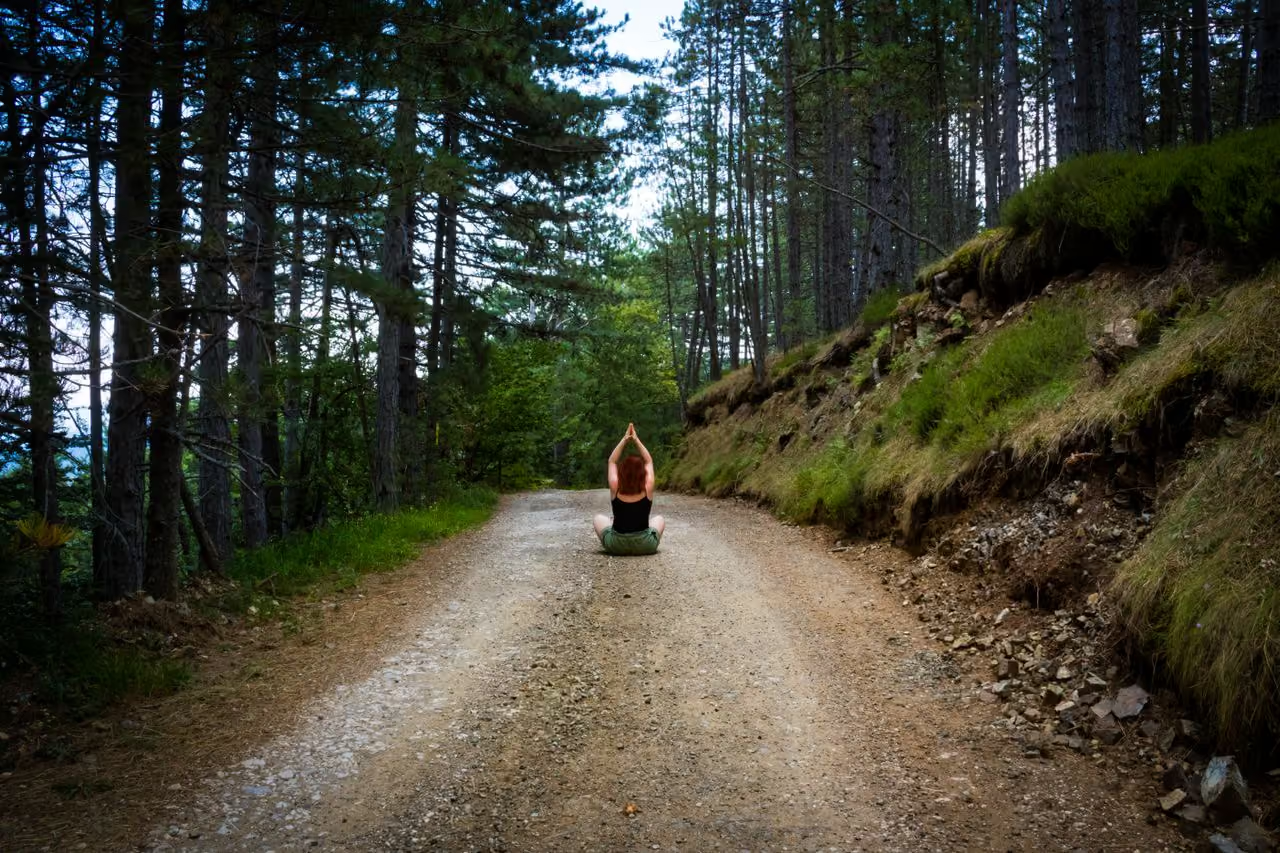
Being in forests and natural landscapes. The Japanese practice of shinrin-yoku — forest bathing — describes what many people have always known intuitively: that time spent in forests, without agenda, produces measurable restoration of the nervous system. From an earth spirituality perspective, forests are earth energy expressed at its most complex and abundant — the accumulated patient work of centuries of growth, decomposition, relationship, and regeneration.
Earth energy becomes shadow when it loses its relationship to the other elements.
Earth without fire becomes stagnant — too much stability, not enough movement or passion, the comfortable rut that never gets examined.
Earth without water becomes rigid — material security without emotional flow, the house full of things but empty of feeling.
Earth without air becomes dogmatic — adherence to the practical and conventional without the ability to think differently or question assumptions.
The spiritual practice of earth is not just grounding but also the willingness to let the earth cycle — to allow things to die back into the soil, to compost what has run its course, to trust that decay is not failure but transformation. The earth that doesn’t cycle becomes depleted. The earth that does becomes rich.
Go outside. If you can, take your shoes off.
Find a patch of ground — grass, dirt, even pavement if that’s what you have — and stand on it. Feel the surface under your feet. Feel the weight of your body dropping into it. Take three slow breaths.
Notice that the ground is holding you. It has been holding you your entire life, without effort, without requiring anything of you in return. Every footstep you’ve ever taken, it was there.
Stay for as long as you want. You don’t need a script or a visualization or a specific intention. You just need to notice what is already happening: you, held by the earth, breathing in a body, alive on this specific ground.
That’s the practice. Start there.
Don’t forget to follow Kellee for the latest news and music:
add soundcloud, IG





Sign up to get our latest news and stay connected.
Thank you! Your submission has been received!
Oops! Something went wrong while submitting the form



.avif)

.avif)
