
If you’ve spent any time in crystal shops — physical or online — you’ve almost certainly bought something that wasn’t exactly what you thought it was.
This isn’t always deception. Sometimes it’s the seller genuinely not knowing. Sometimes it’s industry terminology that’s misleadingly vague. Sometimes it’s a long chain of suppliers where the misrepresentation happened three steps back and the person selling to you has no idea. And sometimes it is deliberate misrepresentation, because the crystal market is largely unregulated and the margins on glass sold as rare stone are very good.
This piece isn’t an argument that crystals are scams or that the spiritual use of crystals is woo woo nonsense that deserves to be debunked. That’s a different conversation, and a less interesting one. The crystals in this series — the rose quartz and the citrine and the lapis lazuli and the selenite — are real minerals with real properties and real histories of use across genuine spiritual traditions. That’s worth taking seriously.
What’s also worth taking seriously: knowing what you’re actually buying, what’s been done to it, and what that means for how you work with it. Those are separable questions, and they all have honest answers.
Before getting into specific materials, it helps to establish that “not natural” covers a very wide range of things, not all of which are equally concerning. Sometimes stones are polished or treated, which doesn't meaningfully change what they are or how they function. It becomes more concerning as you move down the line and find pressed or dyed counterfeits, or even deliberate fakes. And somewhere in the middle is the interesting question of lab-grown crystals, which are materially identical to their counterparts that come out of the ground, but lots of people view as decidedly "not the same thing."
At one end: a natural crystal that has been polished or tumbled. The original material is entirely genuine; human hands have shaped it. Nobody would seriously object to this.
Next: a natural crystal that has been heat-treated to enhance or alter its color. This is standard industry practice for many stones — including citrine, which is frequently heat-treated amethyst, and tanzanite, which is almost always heat-treated. The mineral is real; its color has been altered by a process not unlike what happens naturally underground, just faster. This is disclosed inconsistently in the crystal market.
Next: a natural crystal that has been coated — aurora or aura treatments, for instance. The base mineral is real; a manufactured surface has been added. This changes the stone’s appearance significantly and should always be disclosed.
Next: a reconstructed or pressed stone — powdered natural mineral compressed into a shape. The material is technically natural in origin but has been so thoroughly processed that calling it a natural crystal is a stretch. Common with turquoise and lapis lazuli.
Next: a dyed stone. The mineral base is real; the color is entirely artificial. Dyed howlite sold as turquoise is the most common example.
At the other end: glass or synthetic material presented as a natural crystal. Opalite sold as “sea opal,” goldstone sold as a natural mineral, green glass sold as moldavite. The material has no geological connection to the stone it’s imitating.
Each of these requires a different response — and for spiritual practice, each raises different questions. We'll explore them all and then get to the good stuff -- a practical framework for deciding whether any of this matters to you for your own practice, and if it does, how much.
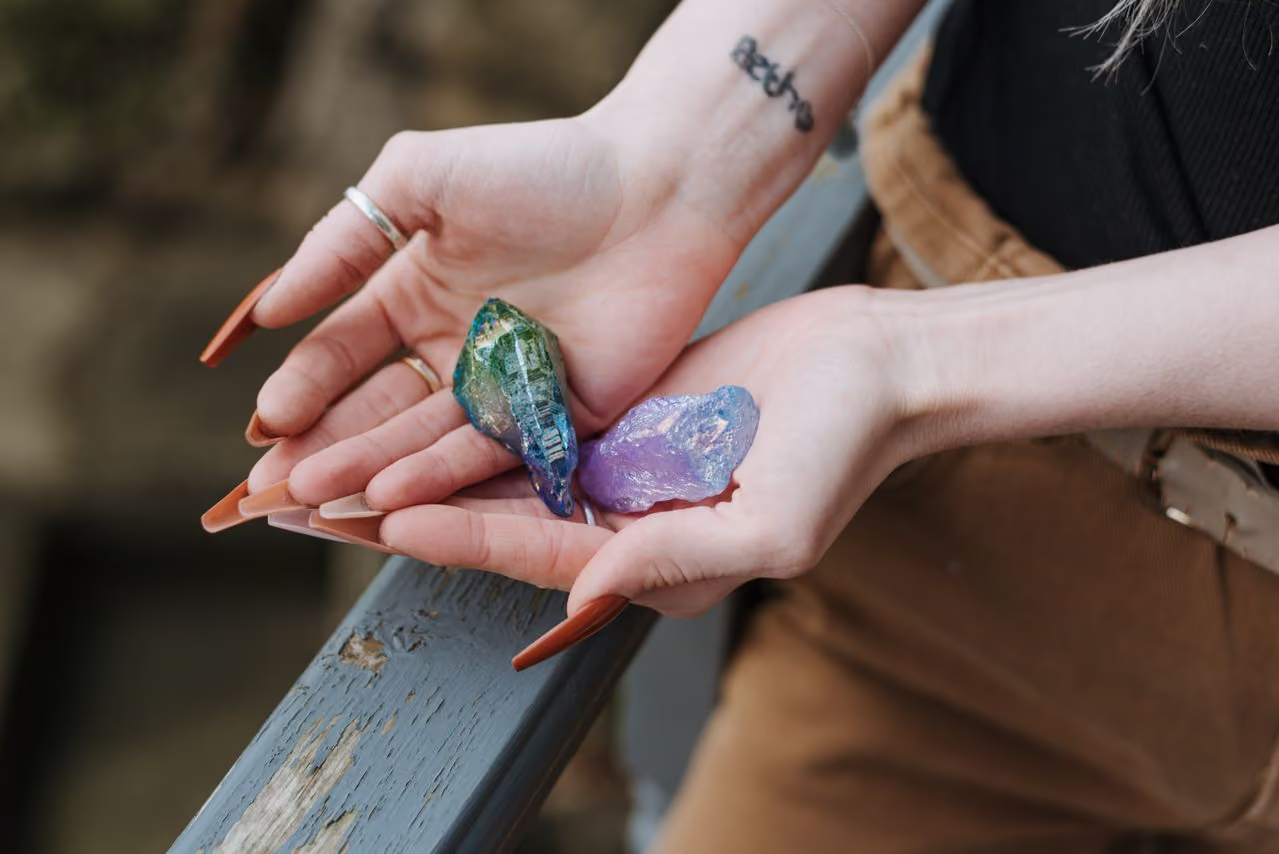
Angel aura. Rainbow aura. Titanium aura. Aqua aura. Flame aura. The naming is evocative, and the stones are genuinely striking — that iridescent rainbow shimmer over a crystal surface is hard not to find beautiful.
Here’s what’s actually happening: the base crystal — almost always quartz — is placed in a vacuum chamber and bonded with vaporized metals (titanium, gold, platinum, or other metals depending on the treatment and the desired color). The metallic particles fuse with the crystal surface permanently. The result is that iridescent coating.
This process is not natural. The quartz base is real, yes, but the surface is manufactured. A reputable seller will call it “titanium coated quartz” or “aura treated quartz” rather than giving it a name that tries to hide what it is behind pretty, mystical-sounding language.
Now, whether or not this raises red flags depends on what you're looking for out of a crystal practice. If you work with crystals primarily as a connection to the natural world and the slow geological processes that formed them, aurora coating is a significant alteration — the surface you’re interacting with is entirely manufactured, and whatever the stone was before has been changed. If you work with crystals primarily as tools for reflection and intention-setting, the coating may be irrelevant — the stone resonates with you, you work with it, the process that created the surface isn’t spiritually material. If you work from the perspective of the stone’s material properties — its chemical composition, its crystalline structure — the base quartz is intact, the surface is a metal treatment, and you can assess each separately.
None of those frameworks is wrong. What’s worth insisting on is transparency: aurora coated crystals should be sold as aurora coated crystals, not as “angel aura crystite” or any other name that obscures what they are.
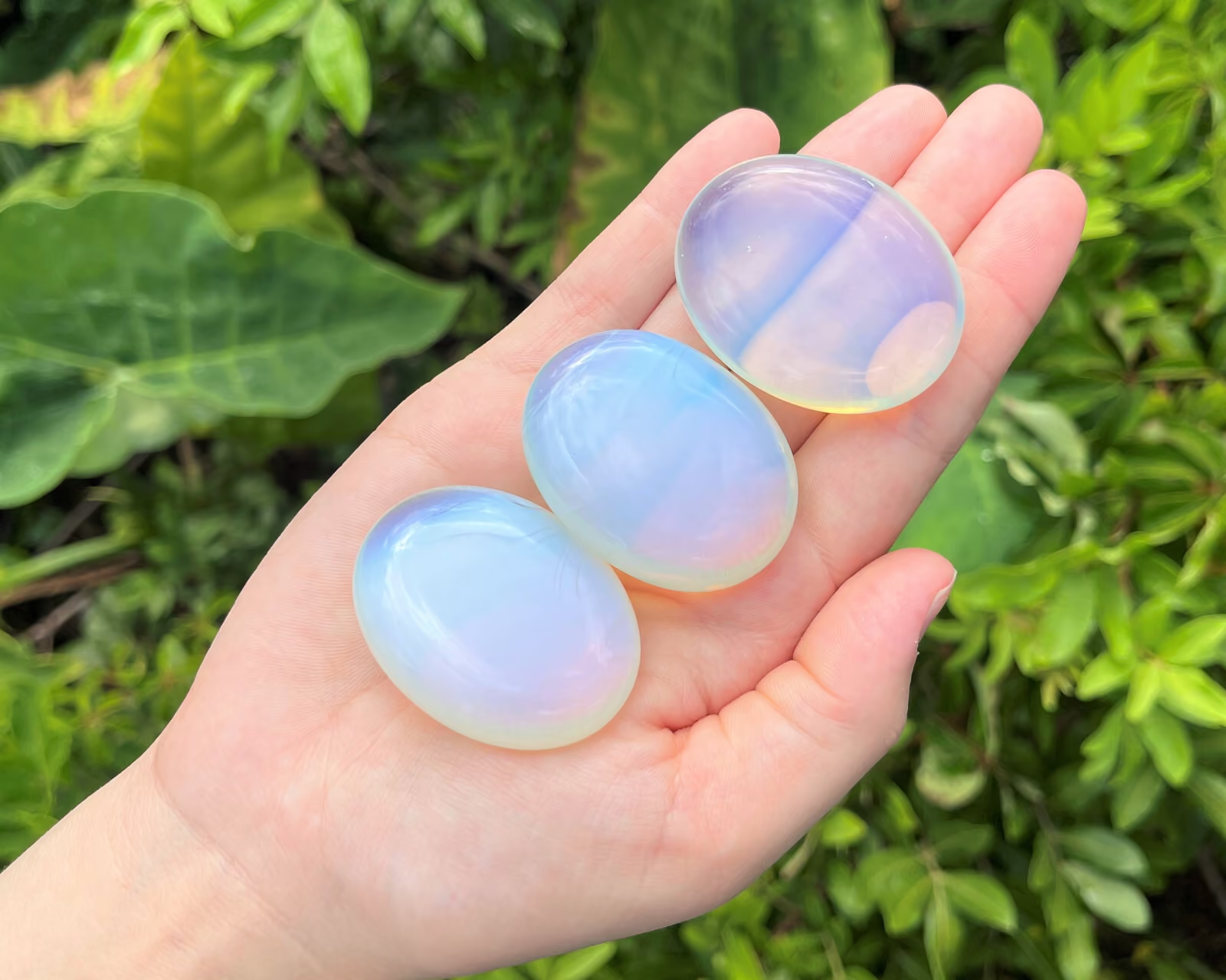
We covered this in our deep dive into the meaning of opalite, but it bears repeating in this context because opalite is the most common misrepresented material in the mainstream crystal market.
Opalite is a manufactured glass — dolomite and metal combined to create an iridescent material. It is sold under dozens of names: sea opal, opal moonstone, Caribbean opal, purple opal, violet opal. None of these names accurately describe what it is. A single reliable name exists: opalite, or opalite glass.
Genuine opal is a mineraloid — a naturally occurring amorphous material with a complex internal structure that produces its play of color. It is significantly more expensive than opalite glass and has a completely different visual character under close examination. If you’re paying $3 for a “sea opal” tumbled stone, you have opalite glass.
As noted in the opalite piece: being man-made doesn’t automatically disqualify it from having a valid spiritual use. But you should know what it is. A seller who calls it “sea opal” or something along those lines without any sort of disclosure is either uninformed or deliberately trying to mislead you.

Goldstone — that warm reddish-brown glass with suspended copper sparkles — and blue goldstone — deep midnight blue with the same starry, glittery effect — are among the most visually appealing materials in most crystal shops. They’re also both glass.
Goldstone has been manufactured since at least the 17th century in Venice, where the technique of suspending metallic particles in molten glass was developed (and kept secret for decades). It’s sometimes called aventurine glass — which is accurate — but it’s not the same as natural aventurine, which is a genuine mineral and is often sold alongside goldstone in ways that blur the distinction.
This is a case where the history and craft of the material is genuinely interesting in its own right. Goldstone is beautiful. The fact that it’s manufactured glass doesn’t make it ugly or worthless. What it means is that a seller calling it “volcanic goldstone” or implying it has a natural, geological origin is not being straight with you.
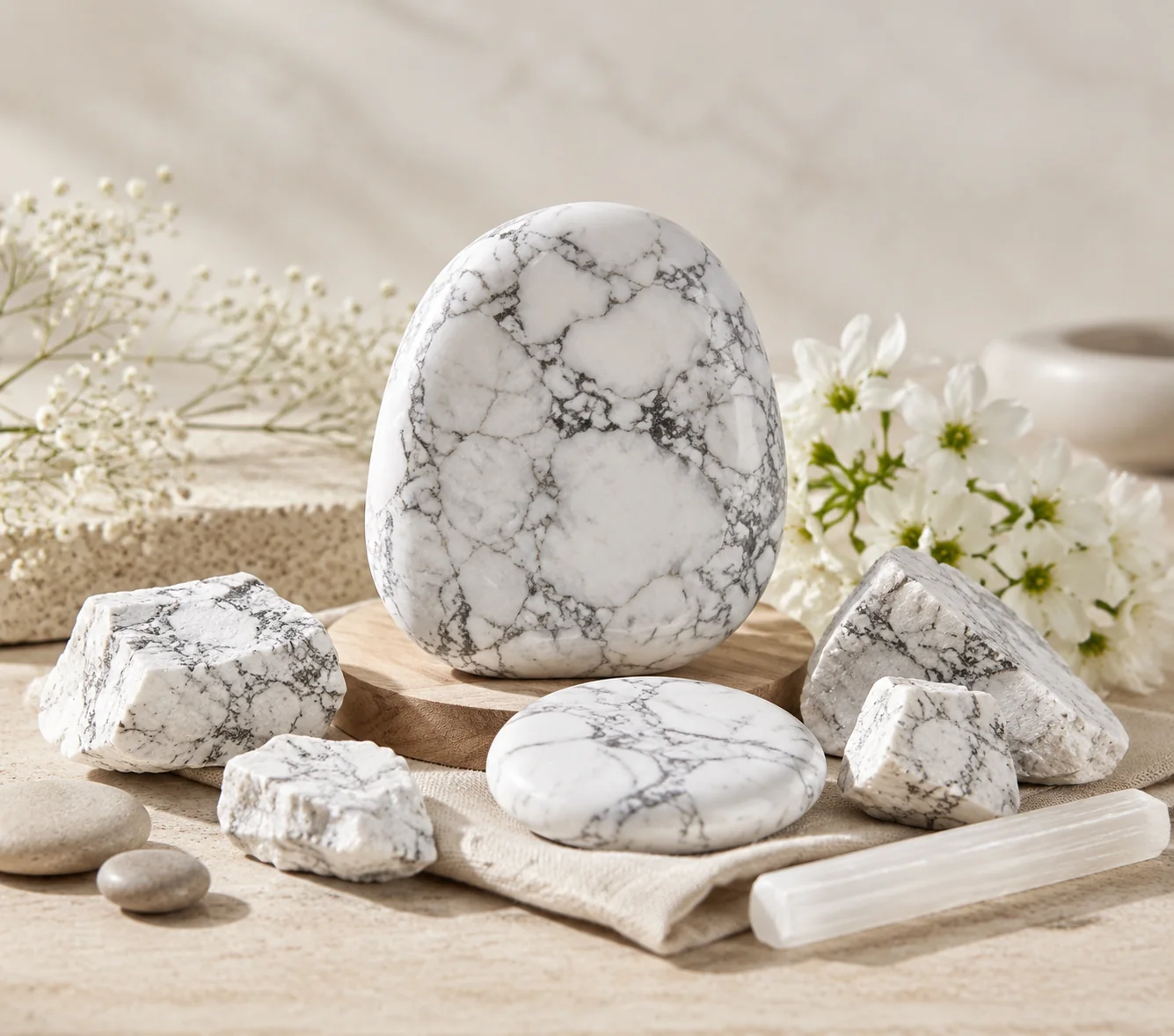
Howlite is a soft white mineral with grey veining that dyes beautifully. Turquoise blue howlite looks, to a casual observer, very much like turquoise. Red howlite looks plausibly like red coral. A seller can buy natural howlite, dye it any color they want, and sell it for significantly more than undyed howlite is worth.
This happens constantly. The majority of “turquoise” sold at price points below genuine turquoise is howlite — and genuine turquoise at retail prices is significantly more expensive than most people expect. Real turquoise from traditional sources (Persian, Sleeping Beauty, Bisbee) is a genuinely valuable stone.
How to spot dyed howlite: the color tends to be unnaturally even, without the variation of genuinely formed turquoise. Under magnification, dye often concentrates in surface cracks and veining. The stone is soft (Mohs 3.5) compared to turquoise (Mohs 5-6). White howlite with blue veining, upon close inspection, often reveals white areas that weren’t successfully dyed.
Other commonly dyed stones: agate (dyed in bright artificial colors), magnesite (dyed and sold as turquoise or other stones), and quartz (surface dyed to approximate colored minerals it doesn’t naturally resemble).
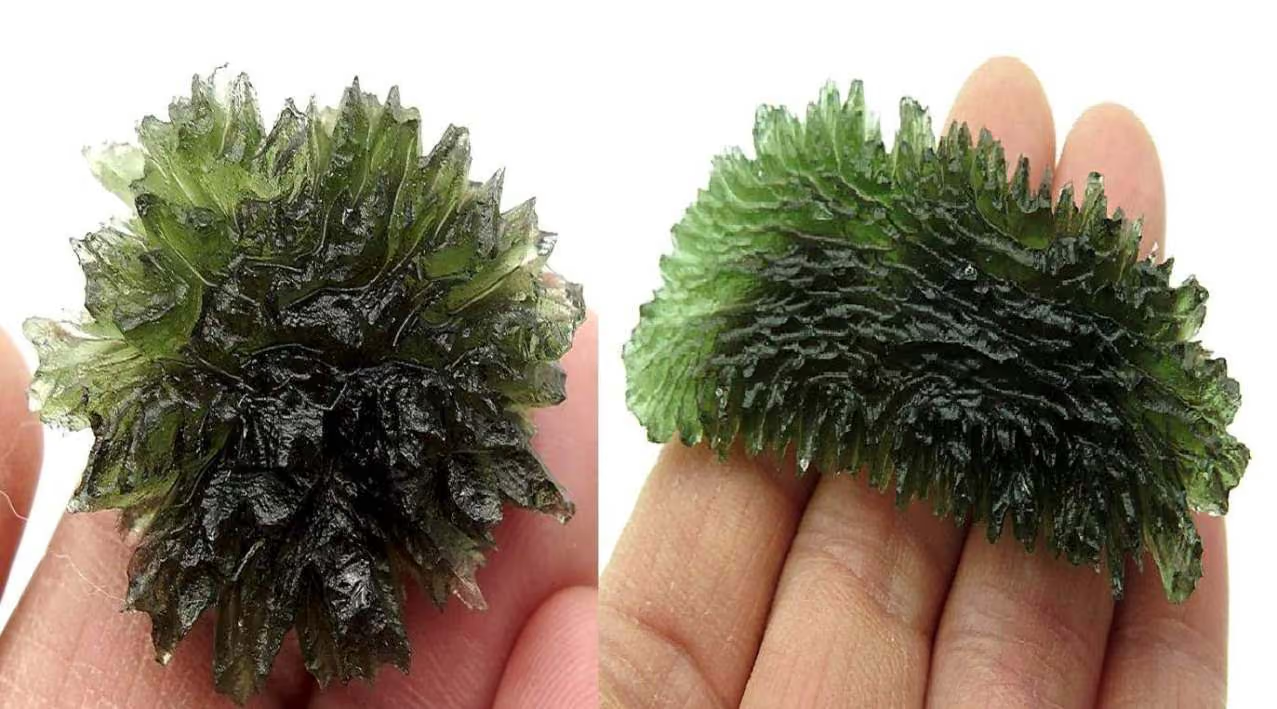
Moldavite deserves its own category because the situation is particularly extreme. Moldavite is a genuine natural glass formed by a meteorite impact approximately 15 million years ago in what is now the Czech Republic. If you think that sounds like a pretty rare material, you are correct. The supply is finite — no new moldavite is being formed — and genuine moldavite is extracted from a limited geographic area under Czech mining regulations.
Its surge in popularity over the past several years has created an enormous market for fakes. Green glass moldavite simulants are produced and sold at scale, often with certificates of authenticity that are themselves fake. The price of genuine moldavite has increased dramatically; the price of fake moldavite has not.
Indicators of genuine moldavite: surface texture that is characteristically wrinkled, etched, and sculptural — not smooth or uniformly shaped. Genuine pieces have a distinctive olive-to-forest green color that’s different from most manufactured green glass. Bubbles are common in genuine moldavite; the internal structure looks different from manufactured glass under magnification. And genuine moldavite from a reputable dealer is not cheap -- to the tune of $50-$100/gram. If it’s cheap, it’s almost certainly not genuine.
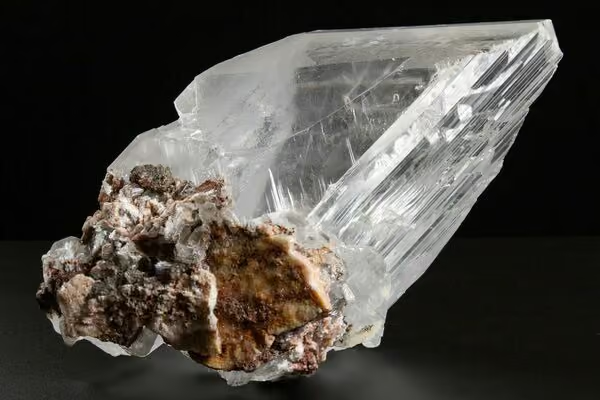
One of the more philosophically interesting cases in this conversation: man-made selenite.
Natural selenite is crystallized gypsum — calcium sulfate dihydrate. Gypsum is also manufactured industrially for use in construction (drywall is primarily gypsum). Lab-grown gypsum crystals, structurally identical to natural selenite at the molecular level, are sometimes sold in the crystal market.
From a purely material perspective, natural and man-made selenite are the same thing: the same chemical compound, the same crystalline structure, the same physical properties. This is different from opalite, which is not structurally related to natural opal at all.
The question of whether natural and lab-grown selenite are energetically equivalent depends entirely on your framework. If crystals carry energy because of their chemical and crystalline structure, they’re equivalent. If crystals carry energy because of their geological formation — the specific conditions of pressure, time, and environment that produced them — they’re not. If crystals work as tools for intention and reflection rather than as repositories of independent energy, the distinction may not matter at all.
This is a genuinely open question. It’s worth sitting with it honestly rather than defaulting to either “it doesn’t matter” or “only natural crystals are valid.”
None of this is to say there's some easy judgement call on what "authenticity" means in a crystal practice, or even how much it matters. Different practitioners have different values, needs, and opinions, which means that it's ultimately up to you to decide what kinds of crystals and stones belong in your spiritual world. It's a lot to consider. But it really boils down to three major factors. Figure out where you fit into these philosophies, and you'll have your north star for how and why to incorporate crystals into your practice.
If what draws you to crystals is their connection to geological time, to the specific conditions that formed them, to the living systems of the earth — then the origin and integrity of the material matters significantly. Aurora coatings change the surface you’re interacting with. Man-made glass has no geological history. Dyed stones are natural minerals with artificially altered appearances. From this framework, knowing and seeking out genuinely natural, unaltered specimens is part of the practice.
If what draws you to crystals is that they help you slow down, hold an intention, connect with a quality you want to cultivate — then the material specifics matter less than the resonance. A piece of opalite glass that genuinely helps you access a quality of calm and transition is doing what you’re using it for, regardless of its geological status. From this framework, transparency matters (you should know what you’re working with), but the lack of natural origin doesn’t invalidate the practice.
Some practitioners are drawn to the specific chemical and crystalline properties of stones — the piezoelectric effects of quartz, the electromagnetic properties of tourmaline, the specific mineral composition of lapis lazuli. From this framework, the distinction between natural and man-made depends on the specific material: lab-grown selenite (structurally identical to natural selenite) might be equivalent; opalite glass (structurally unrelated to natural opal) is not.
Most practitioners operate from some combination of all three, which is why the answers aren’t simple. What matters is knowing which framework you’re working from so you can make decisions that are consistent with what you actually value.
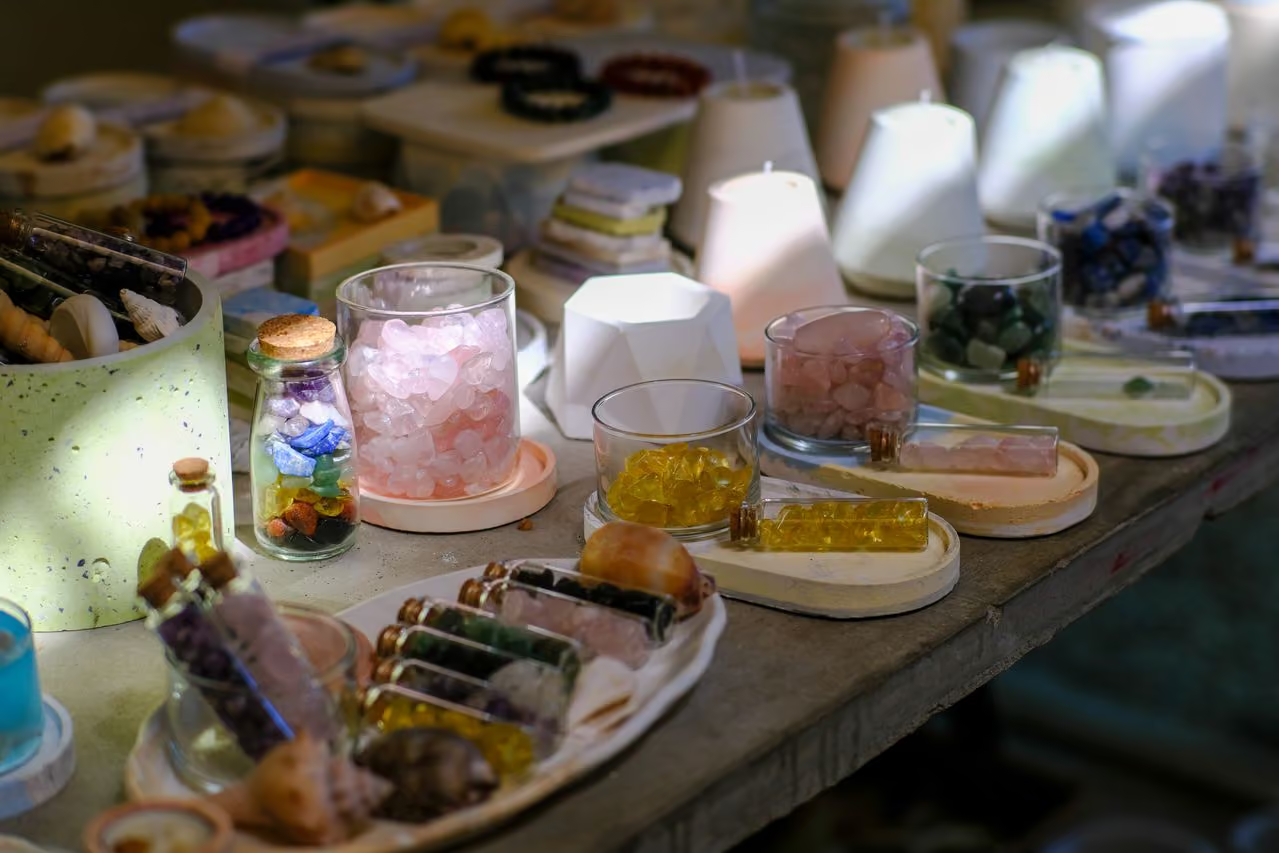
The crystal market, like any unregulated market, rewards both honesty and deception. Here’s how to find the honest end of it.
Transparent naming. A reputable seller calls things what they are: “aurora coated quartz” not “angel aura crystal”; “opalite glass” not “sea opal”; “heat-treated amethyst” not just “citrine.” Vague or evocative names that obscure material nature are a red flag.
Provenance information. For higher-value stones — moldavite, high-quality lapis lazuli, genuine turquoise — a reputable seller can tell you where a specimen came from. Not every seller will have this for every stone, but they should for the expensive ones.
Appropriate pricing. Research what a stone actually costs from reputable mineral dealers before buying. If the price is dramatically lower than market, something has been substituted.
Willingness to answer questions. A reputable seller welcomes questions about whether a stone has been treated, coated, or enhanced. Evasiveness or defensiveness about direct questions is a meaningful signal.
Physical examination when possible. Buying in person, when you can handle the stone, allows for basic authenticity checks that aren’t possible online. Natural crystals have inclusions and variations. Glass is often unnaturally perfect. Dye concentrates in surface cracks.
Community presence. I don't mean a bunch of workshops that have a scammy MLM-type vibe to them. Good crystal shops are often participants in a broader strong spiritual community. You'll see things like posters for gatherings and meet-ups, charity or community-involvement efforts, classes and workshops, supporting local artists, artisans, or practitioners. Staff will be knowledgable. There's an attitude of teaching and sharing rather than "well, are you gonna buy that?" or "you need to get that, it'll change your life." Basically, you'll probably know it when you see it.
The crystal market has a transparency problem. Materials are frequently misrepresented — sometimes through active deception, often through a chain of misinformation that starts somewhere upstream and propagates through sellers who genuinely don’t know better.
This doesn’t mean crystals don’t work. It means knowing what you’re working with gives your practice more integrity, not less. You can work meaningfully with opalite glass if you know it’s opalite glass and have decided that works for you. You can appreciate the beauty of aurora coated quartz while understanding that the surface is manufactured. You can seek out natural, unaltered specimens specifically because that geological authenticity is part of what the practice means to you.
What you can’t do — and what no seller should ask you to do — is make informed decisions without honest information. The stones in your collection deserve to be known for what they actually are. And regardless of what they are, if they work for you, they work for you. Don't let anyone make you feel less than for making an informed choice about what belongs in your spiritual practice!
Don’t forget to follow Kellee for the latest news and music:
add soundcloud, IG





Sign up to get our latest news and stay connected.
Thank you! Your submission has been received!
Oops! Something went wrong while submitting the form


.avif)

.avif)
