
.avif)
There is a particular shade of blue that humans have considered sacred for most of recorded history. Not sky blue, not ocean blue — something deeper and richer, studded with gold, like the night sky on a clear winter evening.
That color is lapis lazuli.
This stone has been traded, treasured, ground into pigment, carved into amulets, and placed in tombs for over six thousand years. It colored the robes of the Virgin Mary in medieval paintings. It lined the funeral mask of Tutankhamun. It was more valuable than gold in ancient Persia. The name itself — lapis, stone; lazuli, from the Persian lāzhward, the place it came from — carries the weight of everything humans have poured into it across millennia of reverence.
Most crystal content treats lapis lazuli as one option among many. It isn't. It's one of the most historically significant and energetically complex stones in existence. What it does — and what it asks of you — is worth understanding in depth.
Lapis lazuli is not a single mineral but a metamorphic rock — a composite of several minerals that form together under specific geological conditions. Its primary component is lazurite, which gives it the deep blue color. The white veining running through it is calcite. The gold flecks scattered across its surface — the detail that made ancient peoples think of stars in a night sky — are pyrite.
The finest lapis lazuli has always come from a single source: the Sar-e-Sang mines in the Badakhshan province of northeastern Afghanistan, which have been in continuous operation for over six thousand years. The same mountains that supplied ancient Egypt and Mesopotamia are still producing lapis lazuli today. There is something worth sitting with in that — the stone in your hand may have come from the same source as the one in Tutankhamun's burial mask.
Secondary deposits exist in Chile, Russia, and Canada, but Afghan lapis remains the most prized for its depth of color and the quality of its pyrite inclusions.
Its Mohs hardness of 5 to 6 makes it softer than quartz-family stones — more vulnerable to scratching and to water damage given its porous nature and calcite content. Handle it with care and keep it dry.
Where rose quartz opens the heart and citrine energizes the will, lapis lazuli works in the mind and at the threshold of perception — the place where ordinary thinking ends and something deeper begins. Its spiritual meanings all orbit the territory of truth, vision, and the courage to see clearly.
🔵 Truth and intellectual honesty. Lapis lazuli has been called the stone of truth across traditions, and that association runs deeper than simple honesty. It works on self-deception as much as on deception of others — the comfortable stories we tell ourselves about why things are the way they are, the rationalizations that keep us from having to change. Working with lapis lazuli tends to make those stories harder to maintain. That can be uncomfortable. It's also one of the most useful things a stone can do.
🔵 Inner vision and intuition. As the primary stone of the third eye chakra, lapis lazuli is associated with the development of intuitive and psychic perception — the ability to know things through means other than ordinary sensory input. For practitioners developing their intuitive capacities, lapis lazuli provides both activation and clarification: it doesn't just open the third eye but helps focus what comes through it into something legible and useful.
🔵 Wisdom and intellectual depth. There's a distinction between intelligence and wisdom — intelligence processes information quickly, wisdom understands what the information means and how it connects to everything else. Lapis lazuli has historically been associated with the latter. Ancient scholars, philosophers, and priests across cultures worked with it or revered it as a symbol of deep knowledge. It supports the kind of thinking that goes slowly and gets it right rather than quickly and superficially.
🔵 Authentic communication. The throat chakra connection makes lapis lazuli particularly useful for anyone working on saying true things more clearly — expressing their actual perspective rather than the version they think will be more acceptable, speaking from genuine knowledge rather than performed expertise, communicating with precision rather than vagueness. For writers, teachers, speakers, and anyone whose work depends on the quality of their expression, this is among its most practical applications.
🔵 Spiritual connection and protection. Ancient Egyptians placed lapis lazuli in tombs to protect the soul in the afterlife. Ancient Sumerians believed it contained the souls of their gods. Across many traditions, the stone's deep blue has been understood as carrying protective spiritual energy — a connection to the divine that shields as much as it illuminates. Many practitioners wear or carry it for this protective quality as much as for its visionary properties.

Lapis lazuli's primary chakra is Ajna — the third eye, the sixth chakra, located between and slightly above the eyebrows. Ajna means "command" or "perceive" in Sanskrit, which gives some sense of what this energy center governs: the capacity to perceive accurately and to act from that perception with authority.
The third eye chakra is the center of intuition, inner vision, clarity of perception, and the ability to see beyond surface appearances to the deeper pattern of things. When it's balanced, there's a quality of clear-sightedness — you trust your own perception, you're not easily misled, and you can see situations as they are rather than as you wish or fear them to be.
When it's blocked or underactive — which skepticism, chronic over-rationalization, and sustained disconnection from intuitive knowing all contribute to — the symptoms are recognizable: difficulty trusting gut feelings, a persistent sense that something is off without being able to name it, an over-reliance on external authority rather than internal knowing. The overactive version produces its own problems: an excess of psychic input without the grounding to interpret it usefully, vivid and disturbing dreams, difficulty distinguishing intuition from anxiety.
Lapis lazuli works on the third eye with real potency. For people new to third eye work, or those who find the third eye area sensitive, shorter meditation sessions with lapis lazuli are advisable before extended use. The stone tends to amplify what's already active in that center — if your third eye is already open and working hard, lapis lazuli will intensify that, which is not always what's needed particularly if this chakra is very active or overactive.
Its secondary chakra, the throat, connects the inner vision the third eye develops to the outer expression that makes it useful. Perception without the ability to communicate what you perceive remains private and incomplete. Lapis lazuli supports the full circuit: seeing clearly, then saying what you see.
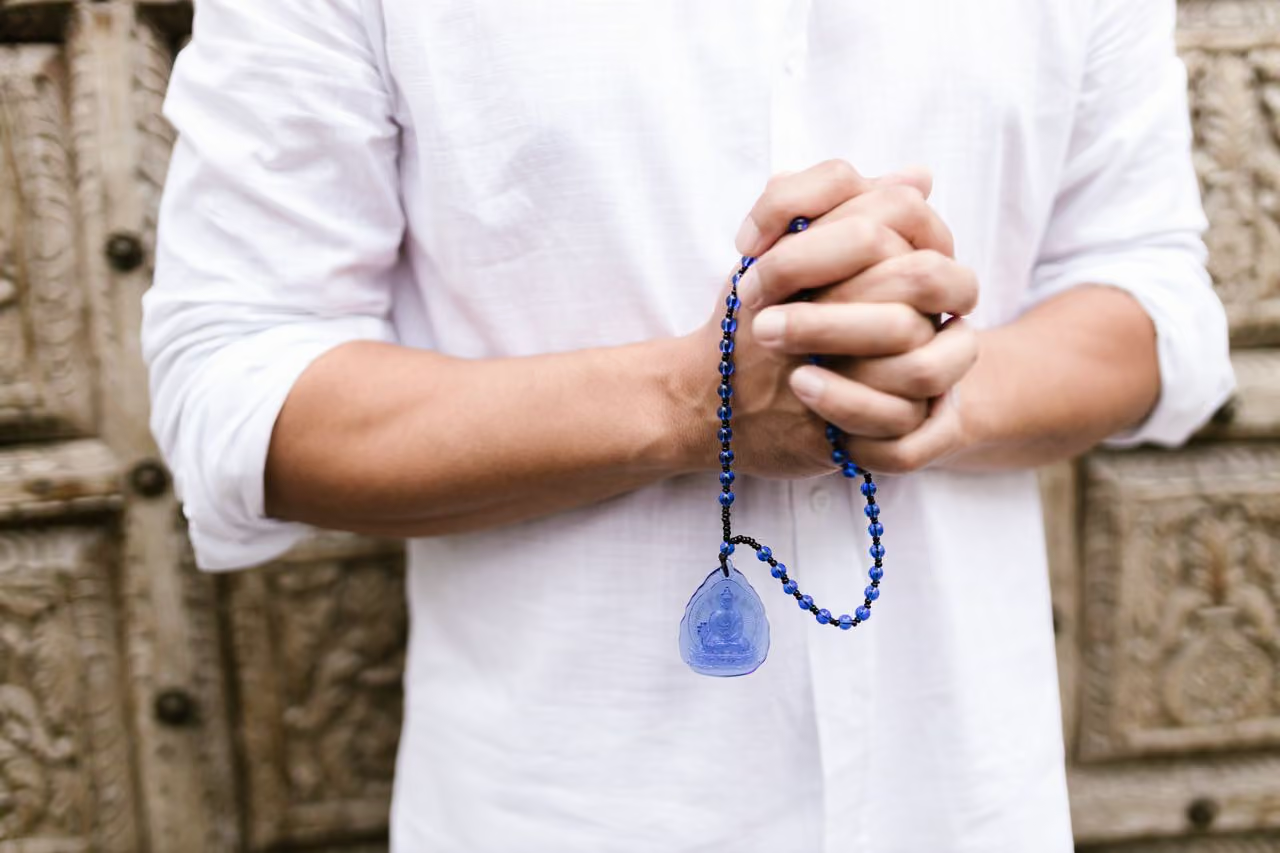
In meditation. Hold lapis lazuli at your third eye — resting it gently against your forehead as you lie down, or holding it in your hands with your attention directed to the space between your eyebrows. Set an intention oriented toward clarity, truth, or inner vision. Lapis lazuli meditation tends to deepen quickly and can produce vivid imagery or sudden insight — approach it with curiosity rather than expectation. It pairs particularly well with music at 852hz, the Solfeggio frequency associated with the third eye chakra.
For writing and intellectual work. Keep a piece of lapis lazuli on your desk or workspace when doing work that requires clear thinking, honest analysis, or precise communication. Writers in particular find it useful for the specific problem of saying exactly what you mean rather than approximately what you mean — the stone seems to sharpen the connection between thought and expression. It can be a powerful, visual grounding tool for busting creative blocks and focusing attention on the work before you.
On your altar. Lapis lazuli as an altar stone brings a quality of gravitas and depth — it grounds spiritual practice in something ancient and serious. It works well at the center of an altar or in a position of prominence, and pairs naturally with objects associated with wisdom traditions: books, sacred texts, symbols of deities associated with knowledge and truth.
Worn at the throat. Given its throat chakra connection, lapis lazuli worn as a necklace or pendant positioned near the throat directly supports honest expression and the courage to say true things. Many practitioners wear it specifically before difficult conversations or situations that require them to speak clearly under pressure.
For dream work. Lapis lazuli placed near the bed — not necessarily under the pillow, as its energy can be intense during sleep — supports vivid, meaningful dreaming and improves the ability to remember and interpret dreams on waking. If sleep disruption occurs, move it further from the sleeping area or work with it only during waking hours.
Crystals are often more powerful in combination than alone, and lapis lazuli has several natural partners in the work it does.
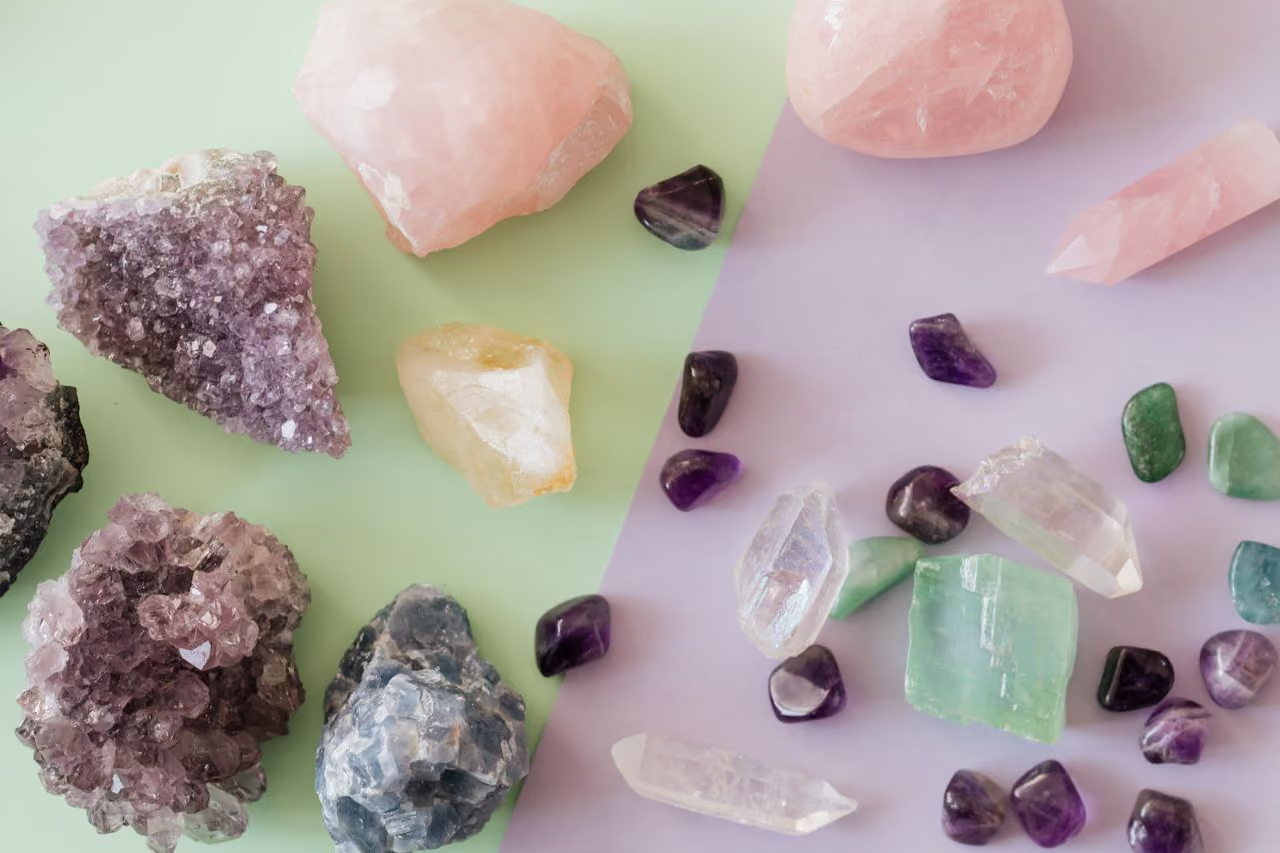
Clear quartz amplifies lapis lazuli's energy across all dimensions — intensifying the clarity of intuition, the depth of meditation, and the precision of expression. Use the combination when you want full intensity; it's not a subtle pairing.
Amethyst is lapis lazuli's natural neighbor in the upper chakra system — third eye and crown working in concert. Where lapis lazuli sharpens perception and expression, amethyst brings spiritual protection, calm, and the receptive stillness in which deep insight arrives. Together they create a complete upper-chakra meditation toolkit.
Sodalite is closely related to lapis lazuli in both appearance and energetic quality — both are royal blue, both work with truth and the third eye, but sodalite tends to be gentler and more mentally oriented while lapis lazuli goes deeper and more intensely. The combination builds gradually toward clarity in a way that feels more accessible for people new to this type of work.
Rose quartz might seem an unlikely pairing for a stone of intellectual truth, but the combination of open heart and clear perception is one of the most useful in practice. Truth without compassion can be weaponized; compassion without truth can become enabling. Together, lapis lazuli and rose quartz support honest engagement that is also kind.
Selenite provides the cleansing and light-bringing energy that balances lapis lazuli's depth and occasional heaviness. When working with lapis lazuli through difficult self-examination, selenite alongside it lifts what's been revealed rather than leaving it sitting heavily.
Lapis lazuli needs regular cleansing — it works actively in deep energetic territory and accumulates what it moves through. Monthly cleansing at minimum, and after any session that felt particularly intense or emotionally charged.
Two things to avoid: water and salt. Lapis lazuli is porous and its calcite content makes it vulnerable to water damage — even brief soaking can dull the surface over time. Salt water is particularly damaging. Similarly, avoid prolonged direct sunlight, which fades the rich blue color that makes the stone what it is.
Moonlight is ideal — the stone's connection to night sky imagery makes this feel appropriate as much as effective. Smudging with sage or palo santo works well. Sound cleansing — a singing bowl, tuning fork, or even a sustained vocal tone — is particularly aligned with lapis lazuli's throat chakra connection and many practitioners find it the most resonant method for this stone specifically.
Lapis lazuli doesn't require elaborate ritual. The simplest practice is also among the most effective.
Find a quiet place to sit. Hold the stone in both hands or rest it gently at your forehead. Close your eyes. Take three slow breaths and let your mind settle from whatever it was doing before.
Ask yourself one honest question — something you've been circling without quite landing on. Not a question you already know the answer to, and not one you're hoping to get a particular answer to. An actual question, held with genuine openness.
Stay with it for as long as feels right. Don't force an answer. Lapis lazuli doesn't deliver information on demand — it creates conditions in which what you already know at a deeper level becomes more accessible. The insight may come during the session or in the hours and days following.
Write down whatever surfaces. The stone of truth asks you to be a faithful recorder of what it shows you.
Don’t forget to follow Kellee for the latest news and music:
add soundcloud, IG





Sign up to get our latest news and stay connected.
Thank you! Your submission has been received!
Oops! Something went wrong while submitting the form




.avif)