Image courtesy of CBR
Avatar: The Last Airbender is a children's animated show about a twelve-year-old who can control air and has to save the world. It's also one of the most spiritually literate pieces of popular culture produced in the last thirty years.
If you've spent any time in the spiritual community — or if you've read the Avatar chakra meditation piece on this blog — you already know that the show handles concepts like the chakra system, emotional blockage, and the relationship between inner work and outer power with unusual accuracy and grace. The creators drew on real traditions. Buddhist philosophy. Taoist principles. Hindu cosmology. Traditional Chinese medicine. They did the research and then they dramatized it in ways that land with young audiences who often have no framework for these ideas yet — and land again differently when those same people grow up and start to explore the traditions the show was referencing.
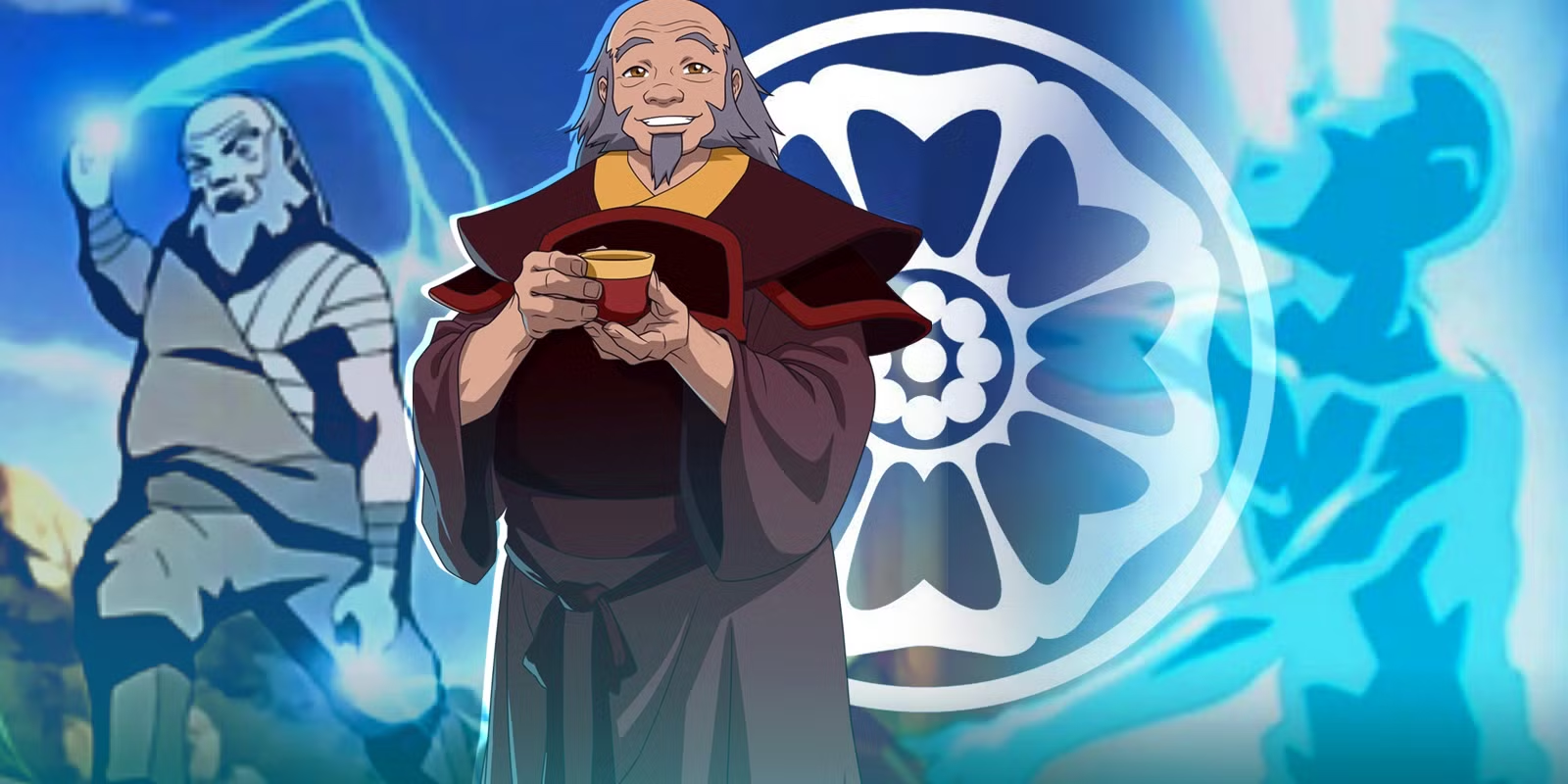
The scene I want to talk about today is from Book 2. Zuko asks Iroh to teach him how to generate lightning. Iroh tells him he can't — not because Zuko lacks ability, but because he lacks the inner conditions that lightning generation requires. And then he teaches him something more valuable: how to redirect it.
What Iroh describes in that scene is one of the most accurate popular culture depictions of chi flow I've ever encountered. And it maps directly onto the principles behind reiki, qi gong, and the broader energy healing tradition that Kellee works within as a practitioner.
For anyone who needs the refresher: Zuko wants to learn lightning generation, a rare and advanced firebending technique. Iroh explains that the reason the Fire Nation's most powerful benders can generate lightning is that they have separated their two energies — yin and yang, the positive and negative — and allowed them to exist without internal conflict. The instant of separation creates the lightning. But Zuko, Iroh says, has too much conflict within himself. If he tried to generate lightning, it would destroy him from the inside.
What he can teach Zuko, instead, is to redirect lightning — to let the energy of someone else's strike flow through him rather than fighting it or absorbing it. The technique requires guiding the energy through a specific pathway in the body: in through the fingers of one hand, up through the arm, across the chest — crucially, past the heart rather than through it — down through the stomach, and out through the other arm and fingers.
Iroh describes why the path matters. Lightning is pure energy. If it passes through the heart, it kills you — the heart can't handle the force of it moving through without direction. But if you create a clear, unobstructed channel for it — if you let it move through you in a complete circuit without resistance — you can redirect it anywhere you choose. You become a conductor rather than a target.
He learned the technique, he tells Zuko, by studying the waterbenders. They don't fight the energetic force of water — they redirect it. The principle is the same.
What Iroh is describing is the foundational principle of chi — the life force energy that flows through all living things in East Asian spiritual and medical traditions.
Chi (also written qi, and called ki in Japanese) is not a metaphor. In traditional Chinese medicine, in qi gong, in tai chi, in acupuncture — chi is understood as a real, functional energy that moves through the body via pathways called meridians. When chi flows freely along these pathways, health and vitality follow. When it becomes blocked, stagnant, or disrupted — by injury, illness, emotional trauma, chronic stress, or unresolved inner conflict — imbalance follows, manifesting physically, emotionally, or both.
The practices built around chi are all oriented toward the same fundkamental goal: restoring the free flow of life force energy through the body. Acupuncture clears blockages in specific meridian points using needles. Qi gong uses breath, movement, and intention to cultivate and circulate chi. Tai chi is chi cultivation in motion — the slow, continuous, circular movements are designed to keep energy flowing without stagnation. And reiki — which we'll come back to — works with the same energy, called ki in Japanese, from the perspective of a practitioner serving as a channel for its flow.
When Iroh talks about creating a clear, unobstructed pathway for the lightning to move through the body — when he talks about becoming a conductor rather than a target — he is describing, in animated form, exactly what every chi-based practice is working toward. The energy doesn't belong to you. You don't generate it or own it. You allow it to move through you in a complete, uninterrupted circuit. That's the whole principle.
The most spiritually sophisticated thing in the scene isn't the technique. It's the diagnosis.
Iroh doesn't just tell Zuko how to redirect lightning. He explains why Zuko can't generate it himself, and why the inability isn't a technical failure but an internal one. Zuko has too much conflict within himself — the war between his desire for power and approval and his suppressed compassion and conscience, between the Fire Nation prince he was raised to be and the person he actually is underneath all of that conditioning. That conflict, unresolved, creates turbulence in his energy. And turbulence in your energy means you can't work with forces that require a clear channel.
This is not just good storytelling. It's a precise description of how emotional and psychological conflict creates energetic blockage — a principle that sits at the heart of reiki, somatic healing, shadow work, and virtually every energy healing tradition.
The understanding is this: unresolved emotion doesn't just exist in the mind. It lives in the body. Chronic tension in the shoulders that won't release. The tightness in the chest that arrives with anxiety. The way grief sits behind the sternum like a physical weight. The jaw that stays clenched through the night. These are not metaphors. They are the physical manifestation of energy that has nowhere to go — that has been suppressed or avoided or pushed down rather than allowed to move through and complete its circuit.
In the chakra system, different energy centers correspond to different emotional territories. The solar plexus chakra — Manipura — governs personal power, will, and identity. When it's blocked or overactive, the symptoms include exactly what Zuko exhibits throughout the first two seasons: rage, shame, the desperate need for external validation, the inability to trust his own judgment. Iroh's diagnosis of Zuko is essentially a chakra reading. His inner fire is burning but has nowhere to go because the pathways are obstructed by what he refuses to feel.
The solution Iroh proposes — learning to redirect rather than generate, to work with energy as it flows rather than forcing it to originate from a conflicted source — is the same solution offered by every energy healing tradition. You don't resolve the blockage by fighting it or suppressing it further. You create the conditions for it to move. You find the path through rather than around.
Reiki is a Japanese energy healing practice developed by Mikao Usui in the early 20th century. Its name combines two Japanese words: rei, meaning universal or spiritual, and ki — the Japanese equivalent of Chinese chi, the same life force energy Iroh is teaching Zuko to work with.
The fundamental principle of reiki is that the practitioner doesn't generate healing energy. They serve as a channel for universal life force energy — allowing it to flow through them and into the recipient, supporting the recipient's own natural healing processes. A reiki practitioner who is tense, blocked, or energetically turbulent is a less effective channel than one who is clear, grounded, and present. The practitioner has to be what Iroh is asking Zuko to become: an unobstructed pathway.
This is why serious reiki practice involves significant work on the practitioner's own energetic health. You can't be a clear channel for energy you can't allow to move through yourself. The inner work and the healing work are the same work.
Reiki specifically addresses blockages in the body's energy field — areas where life force energy is constricted, stagnant, or disrupted. These blockages can be physical, emotional, or spiritual in origin. A skilled practitioner can sense them and work with them, supporting the movement of energy in ways that facilitate healing the recipient may not have been able to access alone.
There's a reason this scene lands differently when you watch it as an adult than when you first saw it as a kid.
As a child, it's a cool action scene. A wise old man teaching his nephew a technique. The philosophical content is there but you absorb it intuitively rather than consciously.
As an adult who has done any inner work at all — therapy, meditation, energy healing, shadow work, somatic practice — the scene reads as something close to a textbook. The relationship between inner conflict and energetic disruption. The futility of trying to force your way through resistance rather than finding the path through it. The idea that becoming a clear channel requires dealing with what you've been avoiding rather than accumulating more techniques on top of the avoidance.
Iroh is one of the great fictional depictions of a healed masculine archetype — a man who had enormous power, misused it catastrophically, lost everything that mattered to him, and came out the other side with genuine wisdom and genuine warmth rather than bitterness or rigidity. His teachings to Zuko throughout the series are consistently about the same thing: you cannot find your way forward by suppressing what's true. The energy you're fighting against is yours. Work with it, not against it.
That's chi. That's reiki. That's shadow work. That's the whole project, really, dressed up in one of the most spiritually sophisticated animated shows ever made.
If you found this through the Avatar chakra meditation post or through searching for Iroh's teachings, and the spiritual concepts here are new to you — that's exactly what this article is for.
The show's creators weren't inventing this material. They were drawing on living traditions that have been practiced and refined across thousands of years and multiple cultures. The chakra system Aang works through in the cave with Guru Pathik is the same system described in Hindu and yogic tradition, the same system the overactive crown chakra and solar plexus posts on this blog are exploring.
The energy flow principles Iroh teaches are the same ones underlying reiki, qi gong, tai chi, and traditional Chinese medicine. The emotional healing work Zuko goes through across three seasons — the gradual, painful, nonlinear process of integrating his shadow rather than suppressing it — is what shadow work and somatic healing traditions have always described.
Avatar got there first for a lot of people. That's not a small thing. It's a genuinely good entrypoint into a genuinely rich set of traditions, and if the show is what brought you here, welcome. There's a lot more where that came from.
Don’t forget to follow Kellee for the latest news and music:
add soundcloud, IG





Sign up to get our latest news and stay connected.
Thank you! Your submission has been received!
Oops! Something went wrong while submitting the form

.avif)

.avif)