One of the first things my teacher told me when I began studying reiki was that self-practice was the point. Not treating others. Not the certificates or the levels. The daily, unglamorous, private work of putting your hands on yourself and letting energy move.
I've been practicing reiki for over a decade now. I hold a Level 2 certification. And the most transformative reiki I've received in all that time hasn't been from practitioners, as much as I value working with them — it's been from my own hands, in my own home, on an ordinary Tuesday morning before anyone else in the house was awake.
That's what this piece is about. Not reiki as something that happens to you in a practitioner's studio, but reiki as something you can develop as a personal practice — something that belongs to you, that you can reach for any time, that doesn't require booking or money or showing up anywhere.
You don't need to be attuned to begin. You don't need special equipment. You need your hands, some quiet, and the willingness to try something that might feel strange at first.
Reiki is often framed primarily as a healing modality you receive from a practitioner. That framing isn't wrong, but it also isn't complete — and it obscures something important about what reiki actually is and where it comes from.
Mikao Usui, who developed the reiki system in early 20th century Japan, taught self-treatment as the primary practice. In the original Japanese lineage, students were expected to practice on themselves daily, consistently, for months before working on others. The logic was simple: you can't be an effective channel for healing energy if your own energy system is depleted, blocked, or unattended.
This isn't unique to reiki. The same principle runs through every serious healing tradition — the healer's own practice, maintenance, and inner work is the foundation that everything else rests on. A reiki practitioner who never does self-practice is working from an empty well, the same way a musician who never listens to music would be.
For people who aren't practitioners, this means something slightly different but equally important: self-practice is how you develop a direct personal relationship with your own energy. It's how you learn what your body feels like when it's open versus contracted, energized versus depleted, balanced versus off. That self-knowledge is foundational to any conscious spiritual practice — not just reiki.
A reiki self-treatment follows the same basic principle as a treatment with a practitioner: hands are placed on or just above areas of the body, held with intention, and energy is allowed to flow. The difference is simply that you're both the practitioner and the recipient.
This sounds simple because it is simple. The complexity — and the depth — comes from consistent practice over time rather than from elaborate technique.
You don't need a special room or an altar or candles, though all of these can help create a container that supports the practice. You need a comfortable position — lying down is ideal, seated also works — and enough quiet that you can turn your attention inward for the duration.
The hands are the primary tool. In reiki, the hands are understood as conduits for energy — they channel it toward where it's needed without the practitioner directing or forcing it. In self-practice, this means placing your hands somewhere on your body, setting an intention for the energy to flow where it's most useful, and then getting out of the way.
Getting out of the way is the hardest part for most people. The mind wants to analyze, to check whether it's working, to wonder if you're doing it right. The practice is learning to hold the hands steady and let the analytical mind quiet while the energy does what it does.
There are traditional hand positions used in reiki self-treatment, developed over decades of practice and refined across lineages. These aren't rigid rules, and experienced practitioners develop intuition about where to place their hands and work fluidly without having to check the list (similar to the way you might refer to your guidebook a lot when you're just starting out with tarot, but after a while you'll realize it's been weeks or longer since you've picked it up). But like the guidebook, they're an excellent structure to help you make sense of the practice when you're first getting started.
Work through the positions in order, holding each for approximately three to five minutes, or until you feel a natural shift — a change in sensation, a sense of completion, a spontaneous exhale.
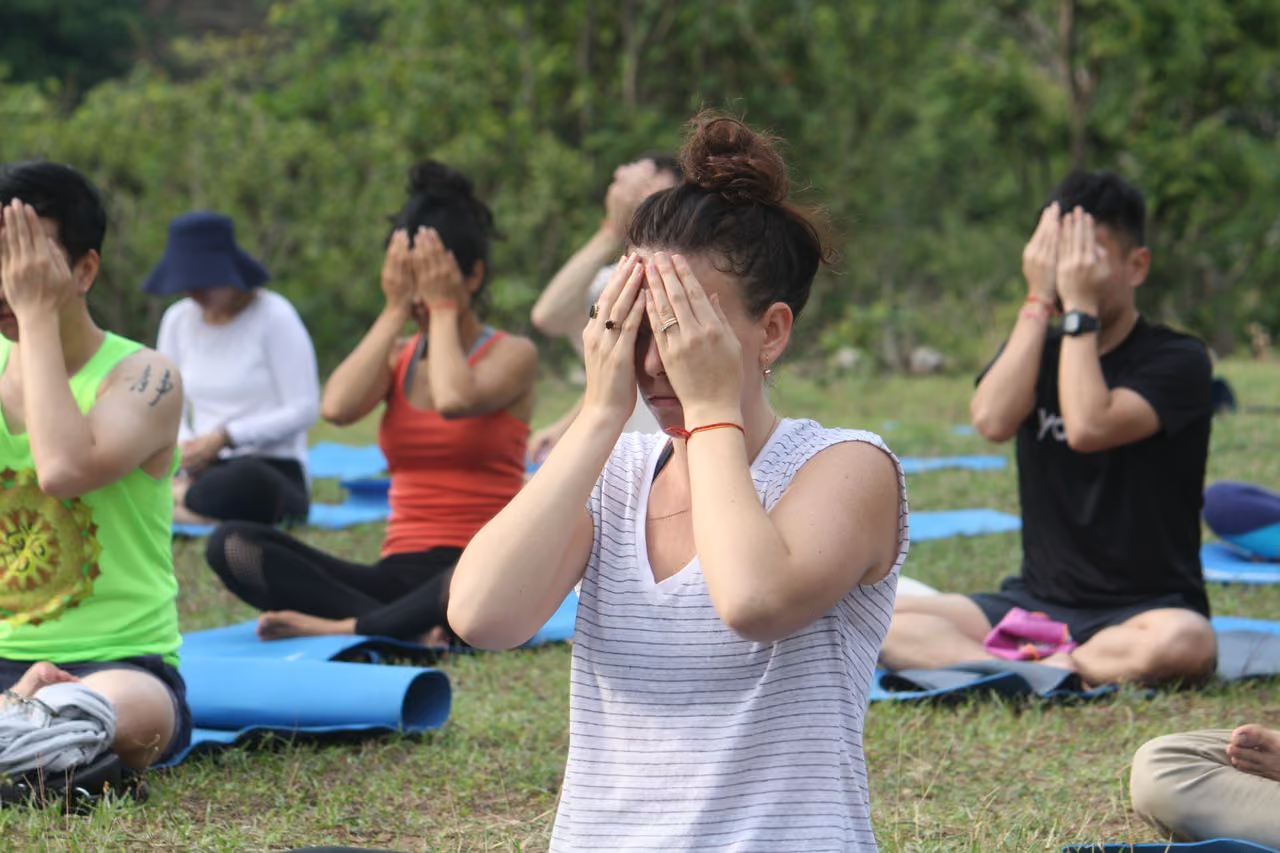
Eyes covered: both palms resting gently over the closed eyes, fingers pointing toward the temples. This position covers the third eye and the crown — centers of intuition, clarity, and spiritual connection. I find this position activates a particular quality of deep quiet that's different from any other. Whatever is spinning in the mind tends to settle here.
Temples: both hands on the sides of the head, palms over the temples. Stress, overstimulation, decision fatigue — they all seem to live here. This position addresses the part of the brain that processes and analyzes constantly. Don't rush it.
Back of the head: hands cradled under the back of the skull, where the neck meets the head. This is where the occipital lobes are — visual processing, memory. It's also where a lot of held tension accumulates without our awareness. Allow the weight of the head to rest into the hands rather than holding the hands up to the head.
Throat: one or both hands resting lightly on the throat, not pressing. The throat chakra — communication, truth, voice. If you've been swallowing something you need to say, or if your creative expression feels blocked, give this position extra time. You can even consider using music or sound to support your work here.
Heart center: both hands over the center of the chest, one on top of the other or side by side. The heart chakra — love, grief, connection, compassion. This position can bring up emotion with surprising suddenness. That's not a problem. It's the practice working. Breathe through it rather than managing it away.
Lower chest / solar plexus: hands moved down to the soft area between the sternum and the navel. Personal power, will, self-worth, the place where anxiety tends to live physically. If you've been feeling powerless, overwhelmed, or scattered -- spend extra time here because you might be experiencing an overactive solar plexus chakra.
Navel area / sacral: hands resting on the lower abdomen, below the navel. Creativity, pleasure, the emotional body, the place where things are felt before they're understood. This position is underrated. The sacral tends to get ignored in favor of the more dramatic upper chakras, but clearing here tends to open creative energy in ways that are immediately felt in daily life.
Lower abdomen / root: hands rested low on the abdomen or moved to the hip points. Grounding, safety, survival, the foundation. If you've been anxious, ungrounded, or dealing with material insecurity — this is where to spend time.
Upper back / shoulder blades: hands on the upper back, between the shoulder blades if you can reach, or placed on the tops of the shoulders. This is where unacknowledged burden tends to accumulate — the weight of things you're carrying that haven't been processed.
Lower back / kidneys: hands on the lower back over the kidneys. Fear — the emotion associated with the kidneys in traditional Chinese medicine — tends to be stored here. The lower back is also where adrenal fatigue registers physically. If you've been running on stress hormones for a long time, give this area significant attention.
In the interest of making this concrete rather than theoretical, here's what self-practice actually looks like for me.
I do it in the morning, most days, before I check my phone. Fifteen to thirty minutes depending on what's available. I lie on my back in bed or on a mat on the floor. I close my eyes. I take three slow breaths to arrive — not a formal breathwork practice, just enough to signal to my nervous system that we're shifting gears.
I set a simple intention. Not elaborate — something like may this practice support my highest wellbeing or, on mornings when something specific is present, may whatever needs to move, move. Then I begin with my hands over my eyes and work through the positions, staying with each until something shifts or until three to five minutes have passed, whichever comes first.
I don't use a timer anymore, but when I was beginning I did — it took the mental monitoring out of the equation and let me actually be present rather than wondering how long I'd been in each position.
Some mornings I feel a lot. Warmth, tingling, energy moving through my body in ways that are difficult to describe but unmistakable once you've experienced them. Some mornings I feel relatively little during the session and notice the shift afterward — a particular quality of calm, a different relationship to the day's first demands.
Both are fine. I've stopped trying to manufacture specific experiences during practice. The practice works whether or not I can feel it working, the way sleep works whether or not you remember your dreams.
You don't need a formal attunement to begin exploring self-practice. Many people experience genuine warmth, tingling, and energetic sensation through intentional hand placement before they've ever studied reiki formally.
What you might find is that beginning without attunement is like reading about swimming versus getting in the water. The concept is clear, you can approximate the movements, and you can learn something real — but there's a threshold of direct experience that the concept alone can't cross.
Attunement — the transmission of reiki energy from a teacher to a student — opens and aligns the practitioner's energy channels in a way that changes what's available in practice. It doesn't give you something external. It activates something that was already there. Most people describe their first post-attunement self-practice as noticeably different from practice before — more heat in the hands, clearer sensation, deeper settling.
If you try self-practice without attunement and find yourself wanting more — wanting the sensations to be clearer, the channel to be more open, the practice to have more depth — that's the right question to be sitting with.
Usui's five principles — the ethical and spiritual foundation of the reiki tradition — aren't just abstract guidelines. They're practice material, and they work particularly well held during self-treatment.
During self-practice, I sometimes hold one principle as the container for the entire session. If I've been caught in worry, I'll set the intention at the beginning — just for today, do not worry — and let that be what the energy is working with. I don't try to stop worrying through willpower. I let the practice create the conditions where worry naturally settles.
This is one of the more practical aspects of the tradition that doesn't get talked about enough. The principles aren't commandments you follow with your mind. They're invitations you accept with your energy.
Consistency matters more than duration. A ten-minute daily self-practice builds more over time than an occasional hour-long session, because you're establishing a relationship rather than performing a one-off intervention.
Morning tends to be the most productive time for most practitioners — before the day's demands arrive, before the phone is checked, before the mind is fully occupied with logistics. The quality of attention available in the first part of the day is different from what's available later.
Evening practice has a different purpose — discharging accumulated stress and tension, creating a transition between the activity of the day and the rest of sleep. Both are valuable. Many practitioners do a brief morning session and a longer evening one.
The honest answer to when is: whenever you'll actually do it. The perfect time that you don't practice is less useful than the imperfect time that you do.
If you miss a day or a week or a month — and you will, because that's how practice works — begin again without judgment. The practice is always available. It doesn't penalize absence. It simply waits.
For me, self-practice doesn't live in isolation from the rest of my spiritual work. It's connected to everything else — the moon rituals, the chakra awareness, the music I make, the activism I do.
What reiki self-practice gives me that some other practices don't is a direct, embodied, daily access point to my own energy system. It's the practice that most clearly shows me when I'm in balance and when I'm not. When my hands heat up over my heart more than usual, something is happening there that needs attention. When the session feels flat and nothing seems to move, I'm probably exhausted in a way that's deeper than sleep will fix.
That self-knowledge — built through years of daily practice — is one of the most useful things I have. Not because it gives me answers, but because it keeps me honest about questions I might otherwise be avoiding.
The energy is always there. The practice is just learning to listen to it.
Don’t forget to follow Kellee for the latest news and music:
add soundcloud, IG





Sign up to get our latest news and stay connected.
Thank you! Your submission has been received!
Oops! Something went wrong while submitting the form
.avif)

.avif)