
.avif)
I have worked as a psychotherapist for decades. I have also worked as an energy healer and studied the intersection of brain neuroscience, quantum physics, and ancient healing knowledge for most of my adult life. I live at the place where these worlds meet — and from that vantage point, the question of how reiki works is one of the most interesting questions in contemporary healing science.
It is not a simple question. The honest answer requires holding what research has established, what it hasn't yet established, and what practitioners have consistently observed across more than a century of practice — without collapsing the complexity into either dismissive skepticism or uncritical acceptance.
What follows is my attempt at that answer.
Before addressing mechanism — how reiki works — it's worth establishing what the research shows it does. These are different questions, and the evidence for the effects is considerably stronger than the evidence for any specific mechanism.
Multiple peer-reviewed studies, systematic reviews, and meta-analyses have examined reiki's effects on human health outcomes. The consistent findings across this literature:
The most robustly documented effect of reiki is its consistent reduction of stress and anxiety. A 2019 study published in the Journal of Evidence-Based Integrative Medicine found reiki significantly more effective than both placebo and no treatment for reducing anxiety and depression and improving overall wellbeing. Multiple studies in hospital and clinical settings have replicated these findings.
Studies across cancer patients, post-surgical patients, and people with chronic pain conditions consistently show reiki reducing reported pain levels. A 2015 study in Pain Management Nursing found reiki more effective than rest alone for reducing pain and anxiety in cancer patients. Research in labor and delivery settings has shown reiki reducing pain perception during childbirth.
Oncology settings have produced some of the strongest reiki research. Multiple studies show reiki reducing the side effects of chemotherapy and radiation — nausea, fatigue, pain, and anxiety — and improving quality of life during treatment. Several major cancer centers now offer reiki as a complementary service for this reason.
Physiological studies have documented measurable changes in heart rate, blood pressure, cortisol levels, and heart rate variability following reiki sessions — all markers of a shift from sympathetic (stress) to parasympathetic (rest and repair) nervous system dominance.
Studies in post-surgical populations show reiki accelerating recovery, reducing pain medication requirements, and improving emotional wellbeing following surgery.
The evidence is not perfect. Reiki research faces genuine methodological challenges — constructing a convincing placebo for an energy healing practice is difficult, sample sizes in many studies are small, and replication across independent research groups is limited. Systematic reviews consistently note these limitations alongside the positive findings. But the pattern of consistent benefit across diverse populations and settings is meaningful and cannot be dismissed.
From a neuroscience perspective, one of the most compelling frameworks for understanding how reiki produces its effects is through its documented impact on the autonomic nervous system.
The autonomic nervous system governs the body's involuntary functions — heart rate, breathing, digestion, immune response, hormonal balance, and the complex cascade of physiological processes that respond to perceived threat or safety. It operates in two primary modes: sympathetic activation (the stress response — fight, flight, or freeze) and parasympathetic activation (rest, digest, and repair).
Modern life produces chronic sympathetic activation in most people. Chronic stress, digital overstimulation, economic precarity, relational tension, and the accumulated weight of unprocessed emotion all keep the nervous system running in a low-grade threat state that over time degrades immune function, disrupts hormonal balance, impairs digestion, elevates inflammatory markers, and compromises the body's capacity to heal itself.
The body's natural healing processes — cellular repair, immune surveillance, tissue regeneration — function optimally in parasympathetic states. When the nervous system is chronically stuck in sympathetic activation, healing is physiologically deprioritized. The body is allocating resources to threat response rather than repair.
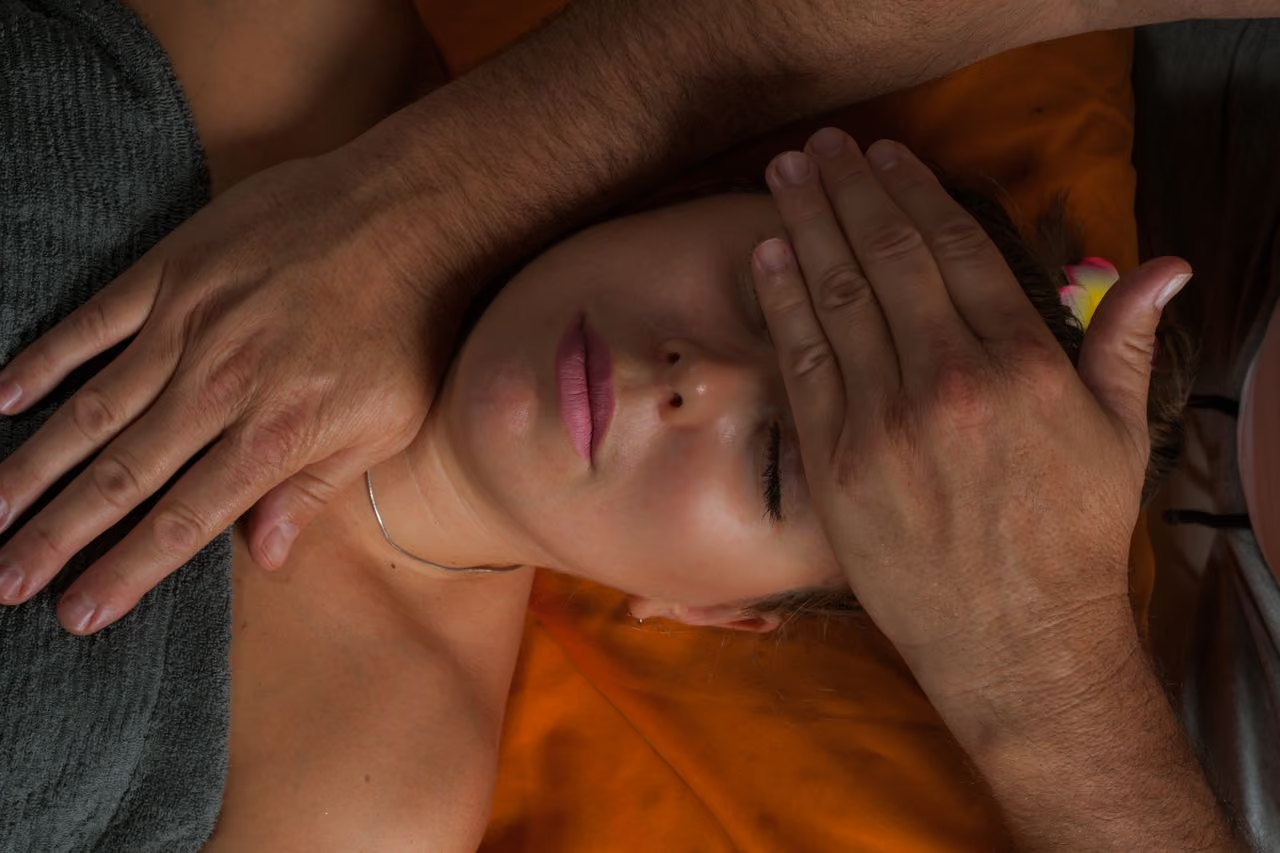
What reiki reliably produces, across multiple physiological studies, is a deep parasympathetic state. The combination of intentional touch, quiet environment, focused attention, and the practitioner's own regulated nervous system creates conditions in which the recipient's nervous system can shift modes — from the chronic sympathetic activation of ordinary life to the parasympathetic state where healing is possible.
From this perspective, reiki works in part by creating the physiological conditions that the body needs to do what it already knows how to do. It is not adding something the body lacks. It is removing an obstacle — the chronic stress state — that prevents the body's own healing intelligence from operating.
This is a significant mechanism even without invoking anything beyond what conventional neuroscience already understands. It explains the documented effects on pain, anxiety, immune function, and recovery. It does not explain everything practitioners observe, but it provides a solid scientific foundation for why reiki is beneficial.
The neuroscience explanation accounts for much but not all of what reiki research documents and what practitioners consistently experience. To go further, we need to engage with an emerging area of scientific inquiry that bridges conventional biomedical science and energy healing: biofield science.
The biofield is a term formally introduced into the scientific literature by the National Institutes of Health in the 1990s to describe the complex electromagnetic and biophotonic field that surrounds and interpenetrates living organisms. Living systems generate measurable electromagnetic fields — the heart's electromagnetic field extends several feet beyond the body and can be detected by sensitive instruments, the brain generates measurable electromagnetic activity, and every cell in the body emits biophotons — coherent light — as a byproduct of metabolic processes.
These fields are not hypothetical. They are measurable with existing technology. What their full significance is for health, consciousness, and healing is an active area of scientific investigation.
Reiki practitioners across traditions describe their work as operating within this field — sensing disruptions, areas of congestion or depletion, and supporting the return to coherent flow. From a biofield science perspective, this description is not mystical. It is a description of working with measurable electromagnetic phenomena that conventional biomedicine has historically underemphasized but that physics and biophysics have long acknowledged.
The work of researchers like Dr. Beverly Rubik, a biophysicist and pioneer in biofield science, and the HeartMath Institute's research on the heart's electromagnetic field and its effects on the nervous systems of people in close proximity, begins to provide a scientific framework for understanding how one person's energy field might influence another's — which is the core claim of reiki practice.
Research has documented that experienced healers can measurably alter the electromagnetic emissions of biological samples, that practitioner heart rate variability coherence is associated with recipient outcomes in energy healing sessions, and that biofield disruptions in the area around the body can precede the development of physical symptoms — suggesting that the field is not merely a byproduct of physiology but may be causally implicated in it.
This research is preliminary. It is not the settled science that the neuroscience of the stress response is. But it points toward a framework in which the practitioner-as-channel description of reiki — the idea that the practitioner facilitates the flow of energy through the recipient's field rather than generating the healing energy themselves — has a basis in physics that was not available to Usui when he developed the system but that contemporary biophysics is beginning to map.
At the frontier of this conversation is quantum biology — a field examining how quantum mechanical effects operate in living systems at scales once thought too warm and wet for quantum coherence to be relevant.
Quantum effects have been documented in photosynthesis, in bird navigation via quantum entanglement in their visual systems, in enzyme catalysis, and increasingly in neural function. The relevance to healing practices is still being explored, but the basic finding — that living systems are not simply classical mechanical systems but operate according to quantum principles at multiple scales — opens questions that classical biology cannot fully address.
Quantum non-locality — the phenomenon in which particles that have interacted remain correlated regardless of distance — provides a framework for understanding healing effects at a distance, including distance reiki, that defies classical explanations but does not defy physics. Quantum coherence — the ability of biological systems to maintain coordinated states across multiple components simultaneously — may underlie the kind of systemic, whole-person effects that reiki and other energy healing practices produce.
I want to be careful here. Quantum biology is a legitimate scientific field. Using it to justify any and all mystical claims is a recognized misuse — sometimes called quantum woo — and I am not making that move. What I am saying is that the quantum properties of living systems are real, documented, and incompletely understood, and that some of the phenomena energy healing practitioners have observed and described for millennia may find their explanations in frameworks that are currently emerging from physics and biology rather than having been available to earlier generations of scientists.
The honest position is that we are at the beginning of understanding, not the end.
A common response to reiki research — particularly among skeptics — is that its effects are explained by placebo. This response deserves a more careful examination than it usually receives.
First, the evidence. Some reiki studies have used sham reiki controls — practitioners who mimic hand positions without intention — and found that genuine reiki still outperforms sham reiki on specific measures. This suggests effects that go beyond simple expectation and therapeutic attention, which is what most placebo effects amount to.
Second, and more fundamentally: placebo is not nothing. Placebo effects involve real neurochemical changes — the release of endogenous opioids, changes in dopamine signaling, shifts in immune markers. A treatment that reliably activates the placebo response is a treatment that reliably produces real biochemical changes in the body. Dismissing something as placebo while treating placebo as trivial misunderstands both.
Third: the question of mechanism is separate from the question of effect. Even if we cannot yet fully explain how reiki produces its documented effects — which we cannot — the documented effects are real. The history of medicine is full of treatments that were effective long before their mechanisms were understood. Aspirin was used for centuries before the prostaglandin inhibition mechanism was identified. The mechanism question is important and worth pursuing. It is not a prerequisite for recognizing that the effects are real.
Beyond what research has established, there is the accumulated observational knowledge of practitioners across more than a century of reiki practice and thousands of years of related energy healing traditions. This knowledge deserves respect as a form of evidence even where it hasn't been formalized into clinical trials.
Practitioners consistently describe the experience of reiki as one of channeling — of becoming a conduit for something that flows through them rather than generating healing energy themselves. This is not merely poetic language, although it is fascinatingly similar to the way musicians, artists, writers, and other creatives experience practice. It reflects a specific phenomenological experience that practitioners across lineages and traditions describe with striking consistency: a sense of energy moving through the hands, of heat or tingling where the field is most active, of something that operates according to its own intelligence rather than the practitioner's direction.
The channel model has interesting resonances with the biofield research. If the practitioner's coherent electromagnetic field — generated by a regulated nervous system and clear intention — creates a resonance effect that supports the recipient's field in returning to coherence, then the practitioner is indeed a conduit in a meaningful technical sense. They are not the source of the healing. They are a regulating influence — a tuning fork, in the metaphor practitioners often use, that helps the recipient's field find its own resonant frequency.
This model preserves both the practitioner's experience and the scientific framework. It explains why practitioner self-care and ongoing practice matter — a depleted or dysregulated practitioner is a less coherent tuning fork. It explains why intention matters — focused intention produces measurable changes in the practitioner's electromagnetic output. And it explains why reiki is not about the practitioner imposing something on the recipient but supporting the recipient's own healing intelligence.
Intellectual honesty requires naming what we don't yet know.
We don't have a complete mechanistic explanation for all of reiki's documented effects. The biofield and quantum biology frameworks are promising but preliminary. The research base, while consistent, is smaller and less methodologically rigorous than the evidence base for established medical treatments.
We don't fully understand the role of practitioner intention in outcomes. Studies suggest it matters. The mechanism by which intention produces measurable effects in another person's physiology is not yet explained by any framework.
We don't understand distance healing from a mechanistic perspective, though quantum non-locality provides a possible framework and practitioner reports of effective distance sessions are consistent.
These unknowns are not reasons to dismiss reiki. They are reasons to remain curious, to support more rigorous research, and to hold the honest position that we are at an early stage of understanding something that has been practiced and observed for a very long time.
The gap between what practitioners have observed and what science has explained is not evidence that the observations are wrong. It is evidence that the science is incomplete.
Don’t forget to follow Kellee for the latest news and music:
add soundcloud, IG





Sign up to get our latest news and stay connected.
Thank you! Your submission has been received!
Oops! Something went wrong while submitting the form
.avif)