

Can you recall a time this has happened to you? You share something hard, and the response comes back too fast, too bright, too polished. “Everything happens for a reason.” “Cheer up.” “Just stay positive!” “Good vibes only.” The words are more than likely meant to comfort, but somehow they feel like a slap in the face. That's the difference between toxic positivity and true energy work — one silences, the other holds space.
As more people lean into wellness culture, energy work, and spiritual practice, it's become easier than ever to confuse the two. Both use similar language. Both talk about vibrations, alignment, and raising your frequency. But they come from entirely different places, and they produce entirely different results. Understanding the difference isn't just a semantic exercise — it's essential for anyone who wants their spiritual practice to actually support their growth instead of undermining it.
That’s why this article is going to focus on:

Toxic positivity is the belief — often well-intentioned — that we should maintain a positive mindset no matter how difficult or painful a situation is. It insists on optimism even when optimism isn't honest. It's the friend who responds to your grief with "at least you had that time together." It's the coworker who meets your burnout with "just manifest something better." It's the inner voice that tells you your anxiety is a "low vibration" you should be ashamed of.
On the surface, toxic positivity looks like hope. Underneath, it's avoidance. It treats difficult emotions as problems to be fixed or hidden rather than experiences to be moved through. It teaches people — subtly, repeatedly — that their pain is inconvenient, that their fear is a character flaw, that their anger needs to be transmuted immediately instead of felt. It leads to a bottling up of uncomfortable emotions, and takes away from the all-too-human experience of navigating all emotions.
This matters because emotions carry information. Sadness tells you something was lost. Anger tells you a boundary was crossed. Fear tells you something needs attention. When positivity is used to bypass those signals instead of listening to them, it doesn't create peace — it creates suppression. And suppressed emotion doesn't disappear. It gets stored in the body, shows up in relationships, and often resurfaces later, louder and harder to manage.
Toxic positivity also has a social cost. It isolates people in their hardest moments by implying that struggle is a personal failure rather than a natural part of being human. Someone who is grieving, afraid, or overwhelmed doesn't need to be told to look on the bright side. They probably just need to feel heard and seen.
True energy work doesn't ask you to bypass your feelings — it asks you to feel them, fully and honestly, and then move that energy somewhere useful. It's rooted in the understanding that emotions are energy in motion, and that healing happens not by denying what's present but by processing it with intention.
Where toxic positivity says "don't feel that," true energy work says "let's feel that together, and then let's release what's ready to go." It might look like breathwork that helps you move through a wave of grief instead of stuffing it down. It might look like a somatic practice that helps you locate anxiety in your body and give it somewhere to go. It might look like sitting in stillness with anger until it tells you what it's protecting.
True energy work honors the full spectrum of human experience. It doesn't rank emotions as good or bad, high vibration or low vibration. It treats every feeling as valid information and every person as capable of holding complexity — joy and sorrow, hope and fear, often in the very same breath.
This is the heart of the distinction: toxic positivity performs peace, leading those who follow it to feel even more inauthentic because they’re covering up what’s really going on. True energy work builds peace, forgiveness, and encourages release one honest feeling at a time.
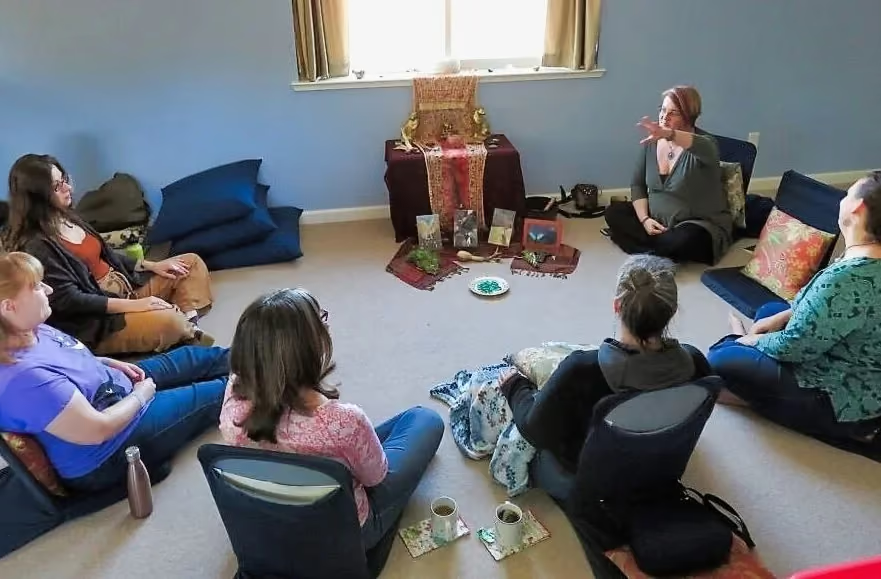
The line between the two isn't always obvious, especially because true energy work and toxic positivity can sound almost identical from the outside. Both might use words like "release," "shift," or "raise your vibration." The difference lives underneath the language, in what's actually being asked of you.
A helpful test: does this practice, belief, or interaction ask you to skip a feeling, or does it ask you to move through one? Toxic positivity wants a shortcut. True energy work wants a process. If a piece of spiritual advice makes you feel like your current emotional state is a problem to eliminate as fast as possible, that's a signal. If it makes you feel like your current emotional state is something worth understanding, that's a very different signal.
Another marker is permission. True energy work gives you permission to not be okay for as long as you need. It doesn't put a timer on grief or a deadline on healing. Toxic positivity, by contrast, often comes with an unspoken expectation of pace — "you should be past this by now," "don't dwell," "keep moving forward." Real growth rarely moves in a straight line, and any practice that punishes you for taking the scenic route isn't actually serving your spirit.
Learning this difference is a practice in itself. It asks you to slow down and notice how something makes you feel — not in a moment of relief, but afterward. Toxic positivity often creates a short burst of relief followed by a deeper sense of disconnection, because the real feeling never actually left; it just went underground. True energy work can feel harder in the moment — it asks you to sit with discomfort — but it tends to leave you feeling more grounded, more whole, and more like yourself.
This is also where leaning into what feeds your spirit becomes so important. Not every practice is right for every person, and not every "spiritual" framework is actually spiritual. Feeding your spirit means choosing practices, communities, and beliefs that make room for your full humanity — the joy and the mess of it. It might mean journaling instead of affirming. It might mean a slow walk instead of a hype playlist. It might mean finding a therapist or healer who lets you cry before they ever ask you to reframe anything.
The practices that genuinely feed your spirit tend to have a few things in common: they don't rush you, they don't shame you, and they leave you more connected to yourself, not less. If a practice consistently makes you feel more disconnected from your own experience, it's worth asking whether it's actually nourishing you or simply keeping you comfortable for someone else.
If you’re interested in building an energy work practice that can have some real benefits, consider seeing a reiki specialist, or taking a reiki course yourself! As someone with ART certification, I can say from first-hand experience that this gentle practice can have a big impact. Reiki is a Japanese healing technique that uses the power of touch on certain areas (nodes, chakras, energy lines) to promote a healthier flow of energy, or ki in Japanese.
When our energy is blocked due to fear, anxiety, trauma, or anything really, it can manifest in our bodies as dis-ease or discomfort. It can also prevent us from feeling like our true selves, and finding contentment, comfort, and peace. Reiki moves that stagnant or blocked energy, allowing us to finally release and let go. The energy moves on and we can feel less heavy.

Recognizing toxic positivity is one thing. Interrupting it — in yourself or in others — is another. Here's how to do it without becoming defensive or shutting down connection in the process.
Notice the urge to rush. The first step is internal. When you feel the impulse to immediately reframe a hard feeling — yours or someone else's — pause. Ask whether the reframe is coming from genuine insight or from discomfort with sitting in the hard thing. That pause alone interrupts most toxic positivity before it starts.
Name what's happening, gently. If someone offers you a positivity platitude when you're struggling, it's okay to name it. You don't need to be harsh. Something like, "I appreciate that, but I actually just need to feel this for a bit" does the job. It redirects the interaction without attacking the person's intent.
Ask for what you actually need. Toxic positivity often shows up because people don't know what else to offer. Being specific helps everyone. "I don't need advice right now, I just need you to listen" gives the other person a clear, doable alternative to the reflexive cheer-up response.
Set a boundary with spiritual bypassing. If a practice, teacher, or community consistently pushes you to "stay positive" instead of processing what's real, it's okay to step back. Boundaries aren't unspiritual — they're often the most spiritual thing you can do, because they protect your ability to stay honest with yourself.
Interrupt your own inner critic. Toxic positivity isn't only something other people do to you — it's something we do to ourselves. Notice when your inner voice tells you that you "shouldn't" feel a certain way. Replace that judgment with curiosity: not "I shouldn't feel this," but "I wonder what this feeling is trying to tell me."
Language matters. The words we reach for shape whether someone feels dismissed or truly supported. Here are honest alternatives to common toxic positivity phrases — for the moments when someone you care about is struggling, and for the moments when you're struggling yourself.
And for yourself, in the quiet moments: instead of "I shouldn't feel this way," try "It makes sense that I feel this way." Instead of "I need to fix this feeling," try "I need to understand this feeling." Small shifts in language, repeated often enough, become a completely different relationship with your own inner world.
Toxic positivity and true energy work can wear similar clothes, but only one of them actually holds you. Toxic positivity asks you to skip the hard parts. True energy work walks you through them. Toxic positivity offers a mask. True energy work offers a mirror. The next time positivity is offered to you — by someone else or by your own inner voice — pause and ask: is this asking me to disappear, or is this asking me to show up? Your spirit already knows the answer.