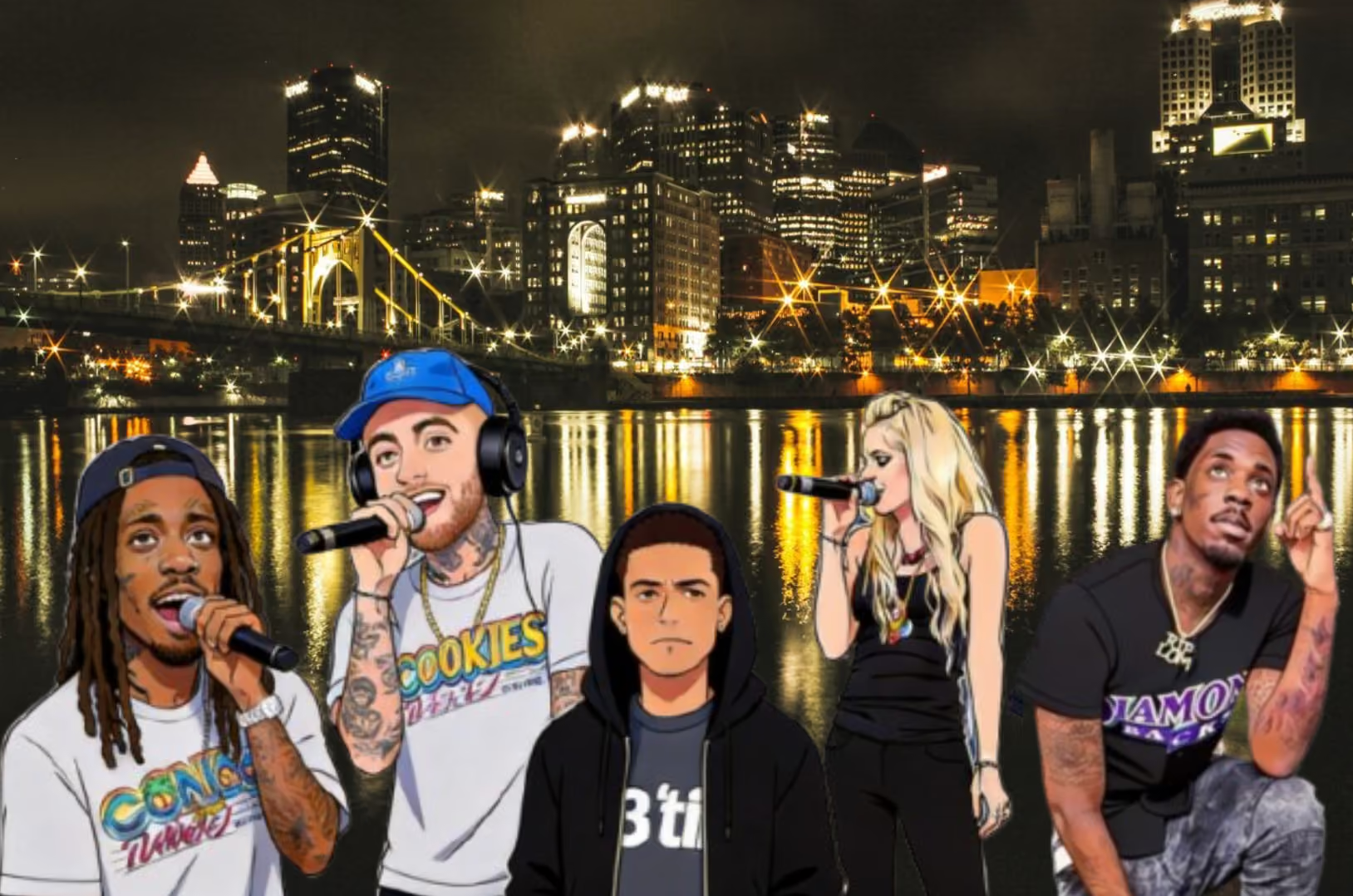
Pittsburgh doesn't get the credit it deserves for hip-hop.
It's not New York. It's not Atlanta. It doesn't have a scene that gets written about in major music publications with the consistency those cities do, and it doesn't produce artists at the same commercial volume. But it has produced artists of genuine, lasting significance. Artists across genres, ranging from The Vogues to The Clarks to Donnie Iris to Anti-Flag to the rappers on this list. Artists who changed what was possible, who built a thriving music scene in a city that wasn't really built around industrial production not artistic expression. Who made music that mattered beyond any regional label.
I've been rapping in Pittsburgh since 2009. I've watched this scene from the inside. I've shared stages, shared studios, and shared the particular experience of being an independent artist in a city that loves its sports teams and its pierogies but has historically been a little uncertain about its musicians.
I've also known some of the people on this list personally. Mac Miller and Wiz Khalifa were both people I'd call friends. Writing about them -- especially Mac -- still carries weight that doesn't resolve just because time passes.
This is the guide I'd give someone who wants to understand Pittsburgh hip-hop from the inside. Not just the names, but the context.
Pittsburgh's geography and history shaped its rap scene in specific ways that are worth understanding before talking about individual artists.
The city is a collection of distinct neighborhoods, many of them historically segregated by race and class in ways that have only partially shifted. Point Breeze, Homewood, the Hill District, Hazelwood, the North Side, Squirrel Hill, Lawrenceville -- each with its own character, its own demographics, its own relationship to the city's industrial past and post-industrial present. Pittsburgh lost roughly half its population between 1950 and 2000 as the steel industry collapsed. What replaced it -- technology, healthcare, universities -- didn't employ the same people or serve the same communities.
The music that came out of those communities reflected that reality. Pittsburgh rap has always had a grittiness that comes from genuine economic precarity — not performed hardship, actual hardship — alongside a particular kind of creative intensity that seems to emerge when people are making something against the grain of what their city is officially known for.
The other thing that shaped the scene was ID Labs, Ia recording studio in Pittsburgh's East End that became the creative hub for an extraordinary concentration of talent. Wiz Khalifa recorded there. Mac Miller recorded there. Countless local artists came through. The studio's founder, E. Dan, along with his partner Big Jerm, helped develop the lo-fi, sample-heavy, emotionally direct production aesthetic that defined Pittsburgh hip-hop at its peak.
Born in Minot, North Dakota, raised in Pittsburgh, Taylor Allderdice High School, ID Labs, Atlantic Records, and then everywhere.
Wiz Khalifa is the most commercially successful rapper Pittsburgh has produced. Taylor Allderdice, his 2012 mixtape, was named after his high school. "Black and Yellow" turned the city's football team colors into an anthem that still plays at Heinz Field. His ascent from Pittsburgh independent artist to global pop star is one of the cleaner success stories in recent hip-hop history. His whole family has been part of the Pittsburgh community in a big way, and I'm so blessed to count his mom Peachie (a total badass in her own right) among my dear friends as well.
What often gets lost in the commercial narrative is how much Wiz contributed to building the Pittsburgh scene before he left it. He was part of a generation of artists -- himself, Mac Miller, Boaz, and others -- who came up together in the city's independent rap community, who were legitimately friends and collaborators, and who proved that Pittsburgh could produce artists with national reach. His success opened doors that didn't exist before.
I've performed on stages in this city where Wiz's shadow was enormous. Not in the way that his shoes were too big to fill and diminished the other performers here. In the way that he's a true hometown artist who left his fingerprints all over this town. And in a lot of ways, those changes have changed what feels possible for every rapper coming up after him.
An article about Pittsburgh rap can't exist without Mac.
Mac Miller -- born Malcolm James McCormick -- was raised in Point Breeze, went to Allderdice, and came up in ID Labs -- was one of the most gifted musicians his generation produced. Not just rappers. Musicians. His relationship to production, to jazz, to the full emotional range of what hip-hop could do, developed at a speed and depth that was evident from his earliest mixtapes and became undeniable across a catalog that kept growing and deepening until it stopped.
He died in September 2018. He was twenty-six.
I knew Mac. He was warm, so funny, and possessed of the kind of creative hunger that recognizes itself in other people. Pittsburgh has produced a lot of artists, but his specific combination of technical ability, emotional intelligence, and willingness to be publicly, vulnerably human in his music was something rare. The grief his death produced in this city and everywhere was genuine and it hasn't fully resolved.
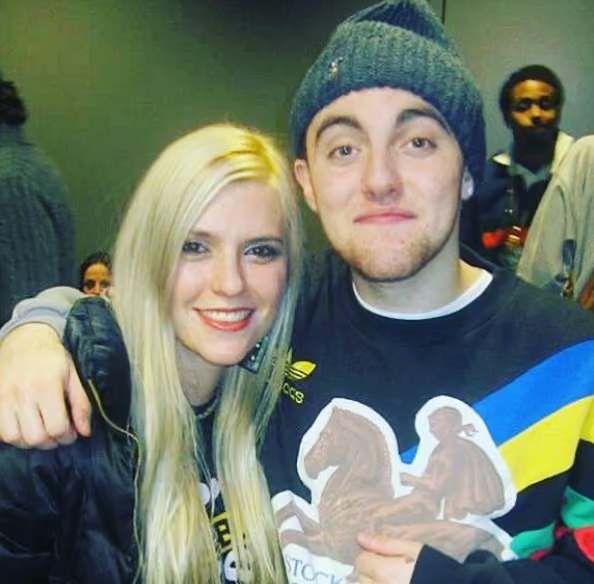
His catalog is a document of a young man figuring out who he was in real time, with the entire process on record. Watching it from the beginning -- the teenage confidence of Best Day Ever, the darker introspection of Watching Movies with the Sound Off, the full arrival of Swimming -- is one of the more extraordinary experiences available in recent hip-hop. Swimming was released five weeks before he died. It's one of the greatest albums of its decade.
If you're in Pittsburgh and you haven't been to the Mac Miller mural in Shadyside, go.
Jasiri X is the Pittsburgh rapper who most clearly operates in the tradition this blog cares about — conscious hip-hop, activism, music as a vehicle for social change.
He's been making politically engaged rap in Pittsburgh for over fifteen years. His work addresses police brutality, racial justice, and community organizing with a directness and craft that earns its place in the same conversations as the most important conscious rap being made anywhere. He's not pursuing mainstream success in any conventional sense — he's building something more durable than a chart position.
He co-founded the community organization 1Hood Media, which uses hip-hop and arts education as tools for civic engagement and social justice work in Pittsburgh. The organization has trained hundreds of young people in media production, storytelling, and activism. That's the version of conscious rap that actually does something with itself.
His work connects directly to the traditions we've written about in the hip hop and spirituality piece and the feminist rap anthems post — the understanding that music isn't just entertainment, that it's a vehicle for truth-telling and community building that has always carried political weight in Black American tradition.
Jimmy Wopo — born Travon Smart, raised in Homewood — was one of the most compelling young voices in Pittsburgh rap before his death in June 2018 at twenty-one, in a shooting in the Hill District.
His music captured something specific about growing up in Pittsburgh's most economically distressed neighborhoods — the texture of daily life there, the specific language and geography, the combination of humor and hardness and occasional tenderness that characterizes that experience when someone is actually paying attention rather than performing it. His "Elm Street" series is an important document of a particular Pittsburgh experience.
Two months after his death, Mac Miller died. Pittsburgh lost two young artists of genuine talent in the same summer. That grief is still present in the city's music community in ways that are hard to fully articulate.
Hailing from Wilkinsburg, Hardo represents Pittsburgh's contribution to the trap rap tradition — high-energy, production-forward, rooted in the specific vernacular and aesthetic of Pittsburgh street culture.
He's been consistent and prolific for over a decade, building a loyal regional following through mixtapes and independent releases that capture the energy of the city's North Side. His style is unmistakably Pittsburgh — the cadence, the references, the attitude — in ways that don't translate easily to other contexts but land completely for audiences who know the city.
Beedie is one of the more interesting current voices in Pittsburgh rap — lyrically ambitious, willing to sit outside commercial trends, and building a body of work that prioritizes depth over accessibility without becoming deliberately obscure.
He's part of a generation of Pittsburgh artists coming up in the wake of Mac Miller's legacy — not trying to replicate it, but shaped by the permission it gave for Pittsburgh rap to be emotionally complex and musically adventurous rather than confined to what was commercially expected of the city.
I'm on this list. I'm going to write about myself in the third person for a moment because it's less awkward than the alternative.
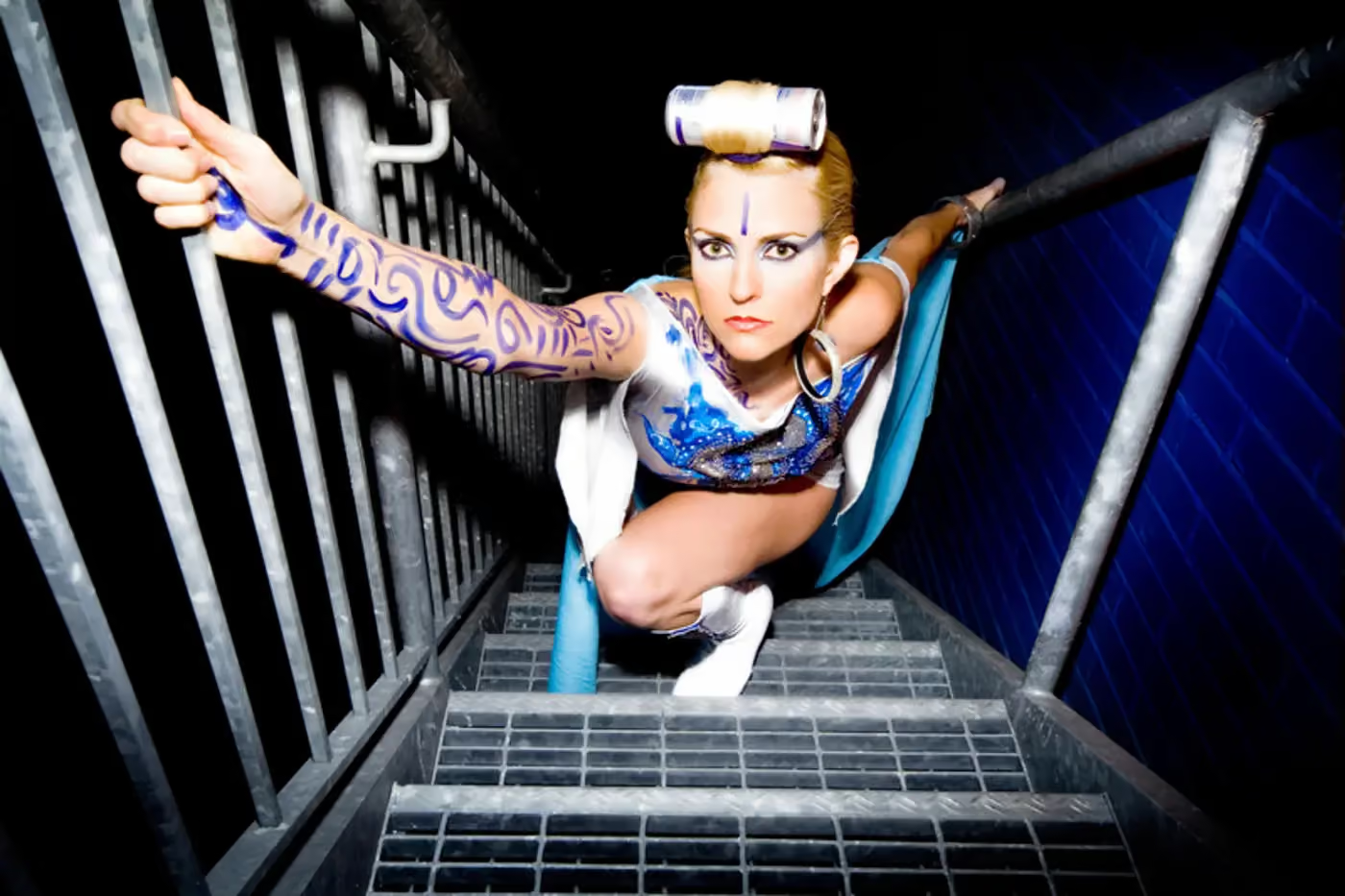
Kellee Maize has been making hip-hop in Pittsburgh since 2009 — six albums, over a million downloads, the Google Female Rapper campaign that went viral and introduced a lot of people to the idea that a female rapper could build a real career without a major label or a conventional path. Her work sits at the intersection of hip-hop, spirituality, feminism, and activism — which is an unusual combination in any genre and a particularly unusual one in a city that doesn't always know what to do with female rappers who have opinions.
The death of two of the city's most significant artists in 2018 cast a shadow over Pittsburgh hip-hop that took a long time to emerge from. But the scene didn't stop.
Pittsburgh today has a diverse and active independent rap community — artists across conscious rap, trap, experimental hip-hop, and everything between. The live music infrastructure rebuilt itself around venues like Club Café, Mr. Smalls, and the Thunderbird, with regular shows supporting local artists alongside touring acts. Open mics, cyphers, and collaborative projects continue to happen across the city.
The city's creative class — anchored by its universities, its tech sector, and its arts community — has grown in ways that support a broader range of musical expression than the Pittsburgh of fifteen years ago. Artists are less likely to leave the moment they reach a certain level. The cost of living, relative to New York or Los Angeles, means you can actually make a creative life here without being forced out by economics.
There's something about cities with Pittsburgh's specific history -- industrial, working-class, ethnically mixed, post-collapse, slowly rebuilding -- that generates a particular kind of creative intensity. The people who stay are committed in a way that people in cities with more obvious opportunities sometimes aren't. The people who leave tend to carry the city with them in their work.
Mac Miller made music that was unmistakably shaped by Pittsburgh even when he was making it in Los Angeles. Wiz Khalifa named a mixtape after his high school. Jasiri X never left and built something that couldn't have existed anywhere else.
The music comes from somewhere real. That's true of the best hip-hop everywhere, but it's particularly visible in Pittsburgh because the city is specific enough, and distinctive enough, that its fingerprints are hard to remove from anything made inside it.
I've been making music here for fifteen years. I'm still here. The city keeps giving me things to say.
Don’t forget to follow Kellee for the latest news and music:
add soundcloud, IG





Sign up to get our latest news and stay connected.
Thank you! Your submission has been received!
Oops! Something went wrong while submitting the form
.avif)
.avif)

.avif)

.avif)