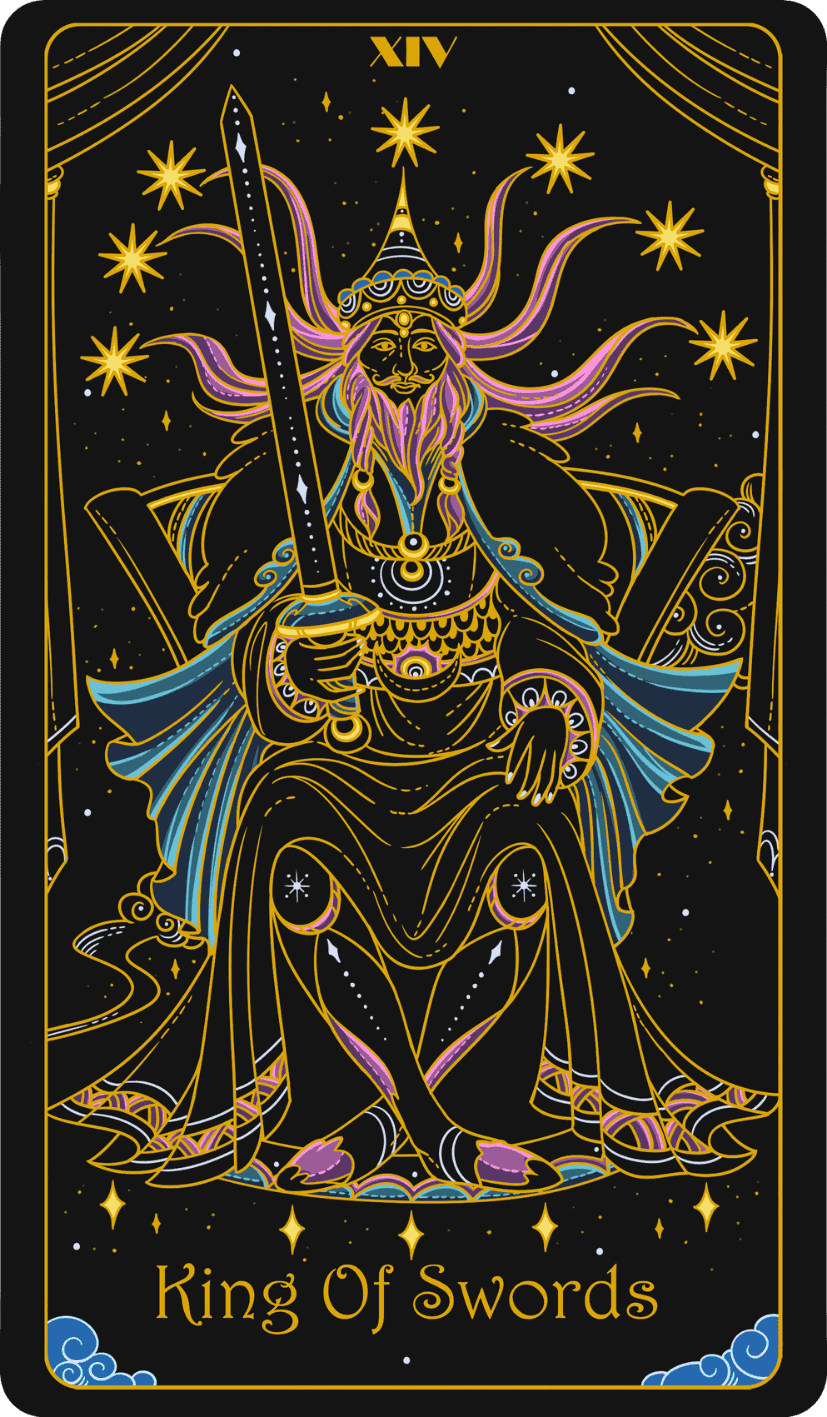
The King of Swords is the tarot's voice of clear thinking, fair judgment, and hard-won truth. When he appears in a reading, he is asking you to step back from the noise of emotion and see your situation as it really is.
Swords are commonly thought of as the suit of the mind—they govern thoughts, words, decisions, and conflict, and they correspond to the element of Air. The King represents the finished product of the journey through the suit: a mind that has been tested and now leads with confidence. As an air sign, this king is also associated with the fixed air sign of Aquarius.
As one of the four kings in the deck, he also represents outward facing mastery and authority. Kings don't learn their element; they rule it. The King of Swords has made his share of mistakes and come out wiser. Now he uses reason, honesty, and principle to guide others and to make the calls nobody else wants to make.
Want to learn more? In this guide, we’ll be covering:
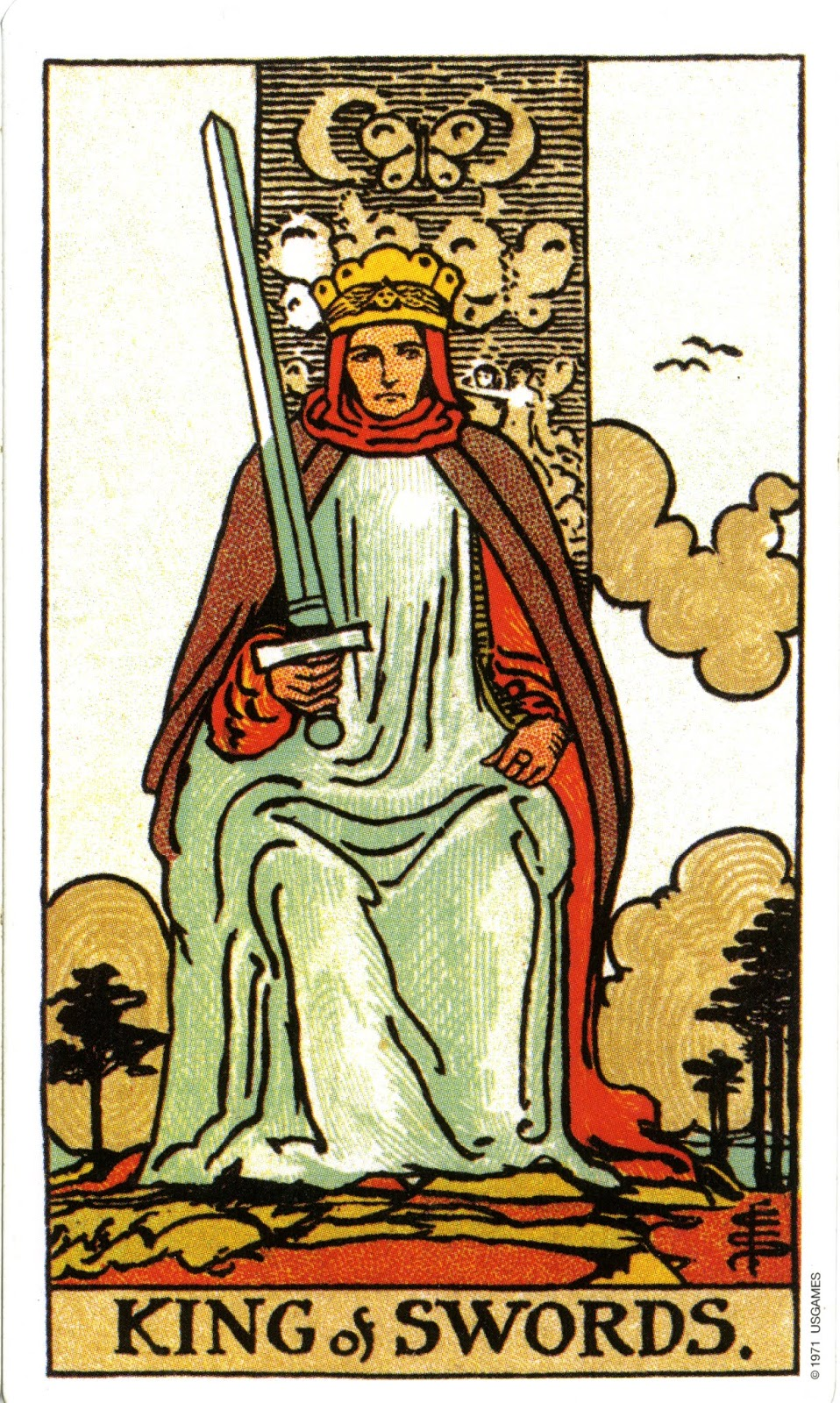
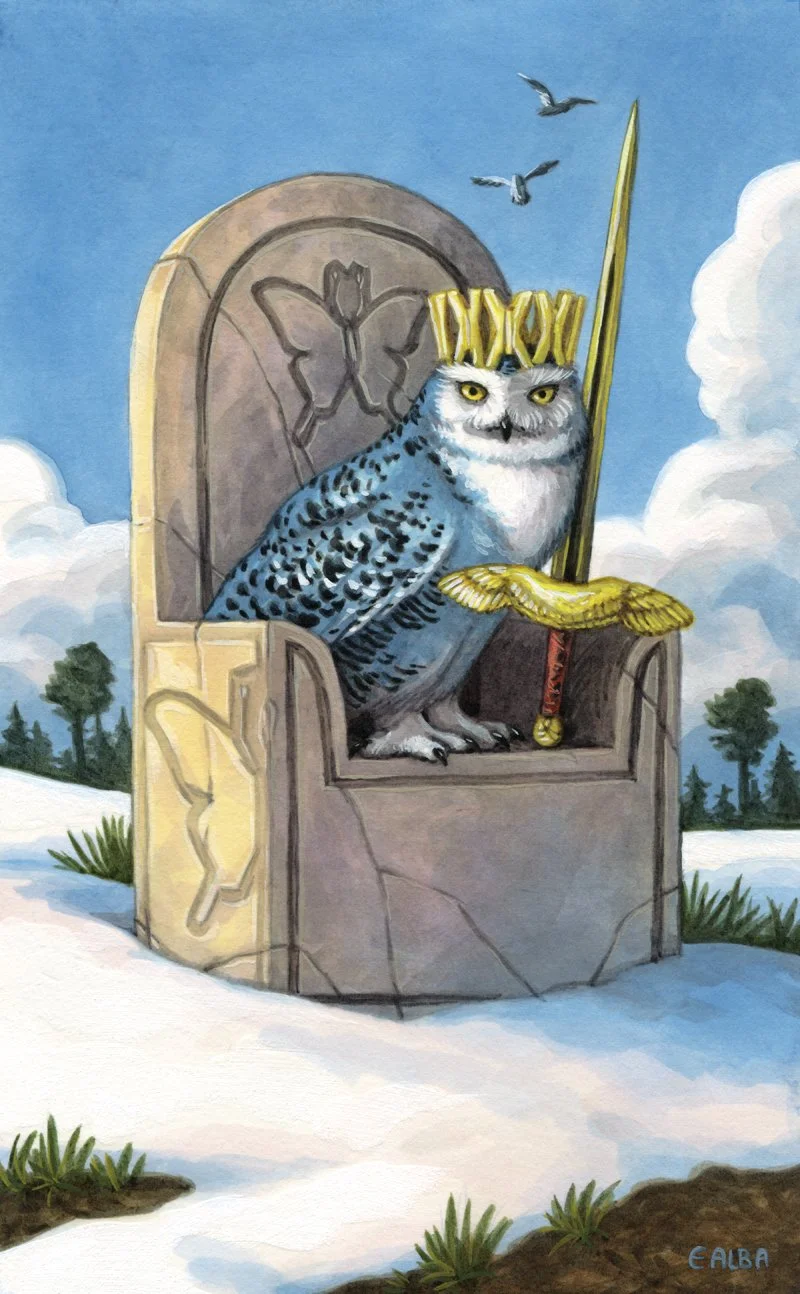
Most modern decks build on the Rider-Waite-Smith imagery, so that is the version described here. Every detail on the card points back to one idea: authority that comes from clarity.
The upright sword. The king holds his sword straight up, pointing toward the sky. An upright blade signals truth, justice, and a clear decision. Truth can heal or wound, and the King knows to wield it carefully. Notice that the sword tilts very slightly to one side. Many readers see this as a sign that even a fair judge leans toward action once he has weighed the facts.
The forward-facing pose. Unlike many court cards, the King of Swords looks directly at the viewer. He has nothing to hide and expects the same from you. This direct gaze speaks to honesty, transparency, and a willingness to face difficult conversations head-on.
The throne. He sits on a tall stone throne, solid and unmoving. Stone suggests stability and rules that do not bend to mood. Carved into the throne are butterflies, crescent moons, and sometimes a small winged figure. Butterflies symbolize transformation and the soul, as well as the element of Air. Depending on your deck, there may also be birds, bats, or other flying insects to denote the air element.
The crown and cloak. His crown marks his authority, and some readers link its winged detail to a mind that rises above petty concerns. His blue tunic reflects calm, communication, and spiritual insight. The purple or red cloak over it suggests wisdom, rank, and the inner fire needed to enforce his decisions.
The sky and clouds. The sky is bright, but clouds gather low on the horizon. Air is the realm of the mind, and clouds are thoughts. The King sits above them, which means he is not lost in worry or confusion. He sees the whole picture.
The birds. Two birds fly in the distance. Birds belong to the air and suggest freedom of thought, perspective, and messages arriving. Some readers see a pair as a nod to the weighing of two sides before judgment.
The trees. Tall, straight trees stand behind him. They echo his upright posture and suggest discipline, growth, and the long view.
Like every court card, the King of Swords can show up in a variety of ways. He can describe a person in your life, a part of yourself, or the energy a situation calls for. Start by asking which fits the question, then let the surrounding cards guide you. Court cards don’t have to be tricky to read. As a tarot reader, I find it helpful to weigh the energy you feel when this card (and any card) comes up and go from there. What’s your gut reaction? What do you notice first? What you feel first intuitively is correct, not what a book says it should be!
Upright, the King of Swords stands for intellectual power, truth, authority, and ethical judgment. Keywords include clarity, objectivity, fairness, honesty, structure, and leadership.
As a person, he is often someone older or more experienced who leads with logic. Think of a lawyer, judge, doctor, professor, analyst, or a manager who values facts over feelings. He can seem reserved or even cold, but he is fair. He tells you the truth even when it stings.
As a part of you, he signals that you have the knowledge and authority to handle what's in front of you. Your mind is sharp, and you can see through confusion that may be clouding others.
As an energy, he asks for a clear-headed, principled approach. Set emotions aside long enough to look at the evidence, then decide.
When the King of Swords appears reversed, his strengths turn inward, turn harsh, or are asking for an adjustment. Keywords include manipulation, cold detachment, abuse of power, and poor judgment. A reversal is suggesting that you need to change how you’re thinking about a situation, adjust your response, or find what’s blocking clarity on an issue.
As a person, a reversed King can point to someone who uses intelligence to control, belittle, or deceive. He might twist words, hide behind rules, or argue to win rather than to find the truth.
As a part of you, the reversal can warn that you are overthinking, being too critical of yourself or others, or shutting down your feelings entirely. It can also show indecision, where you have the facts but won't act on them.
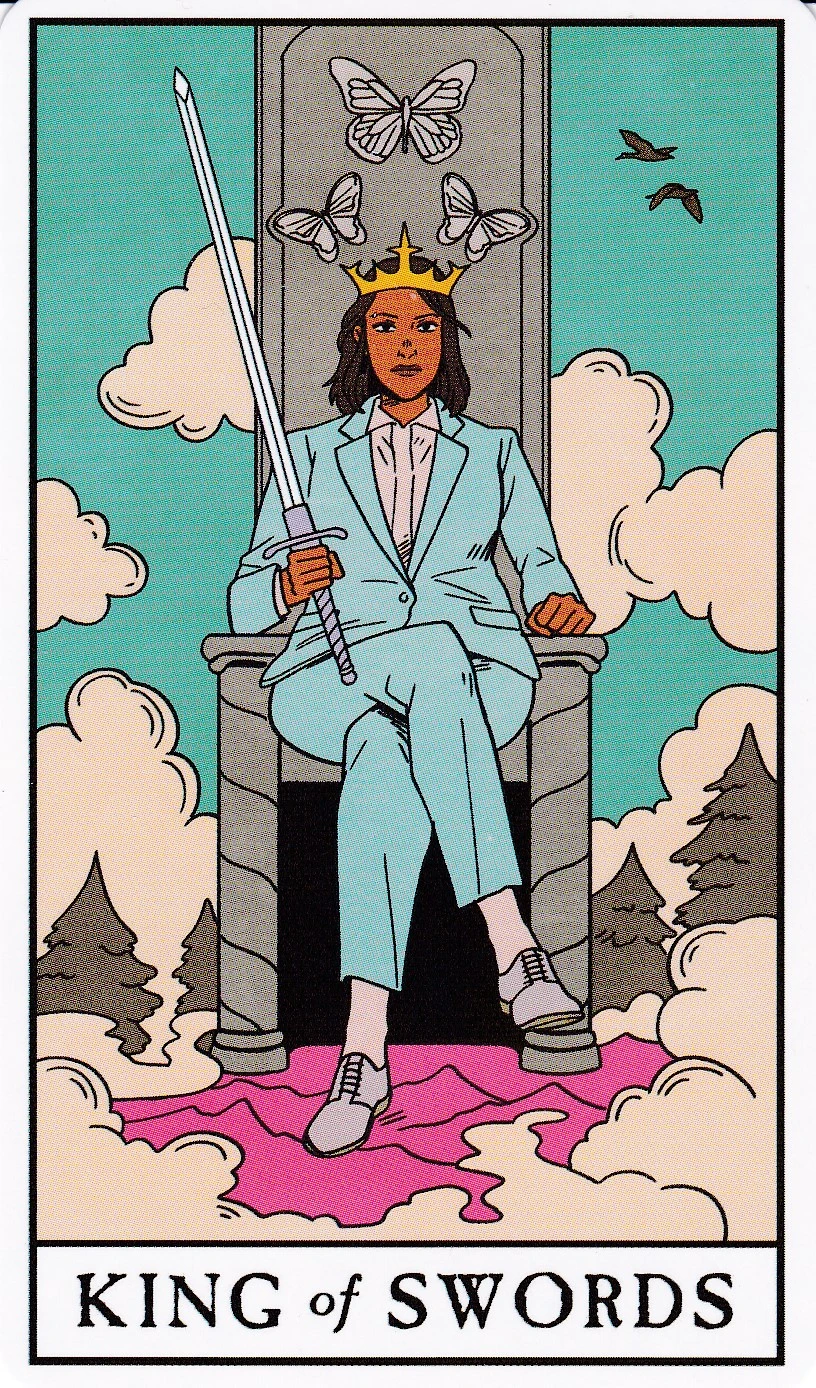
Look at the cards around him. Next to Cups, he may be asking you to balance your head and heart. Beside Major Arcana like Justice or the Emperor, his themes of law, order, and authority are amplified. In a past position, he may describe a lesson you learned the hard way. In an outcome position, he suggests a fair resolution, often one that requires a firm decision.
When the King of Swords appears as advice, his message is simple: think clearly, speak honestly, and decide fairly. Here is what that looks like in practice.
Separate facts from feelings. Your emotions are valid, but they are not evidence. Write down what you actually know versus what you fear or assume. The King trusts what he can verify.
Tell the truth, kindly. He is honest, but honesty is not the same as cruelty. Say what needs to be said, plainly and without drama or being overly emotional. If you’re feeling too much, perhaps it’s time to take a step back and say what you need to say with a cooler head. However, if a conversation has been avoided for too long, he suggests it's time to have it.
Set clear boundaries. The King's upright sword draws a line. Decide what you will and won't accept, then hold to it calmly. Boundaries stated clearly are easier for others to respect. And remember, boundaries are for your benefit, not the benefit of others. You never need to apologize for creating them if they help you. The king of swords confirms this.
Seek expert counsel. Sometimes the King is not you but the advisor you need. A lawyer, accountant, doctor, mentor, or other professional can bring the objective view that is hard to find from inside a situation.
Make the decision. Gathering information is only half his work. The other half is choosing. Once you have weighed both sides, commit and take responsibility for the outcome.
Lead by principle. Ask yourself what is fair, not just what is easy. The King earns respect because his choices line up with his values, even when they're unpopular.
If he appears reversed in an advice position, the message flips into a warning. Check whether you are being too harsh, too rigid, or too detached, and whether someone is using clever words to steer you. Soften where you have been cold, and question where you have been too trusting.
To see how the King works in context, here is a simple three-card Past, Present, Future spread for a fictional querent.
The question: Dana co-owns a small bakery with a longtime friend. The business is struggling, and the two keep clashing over its direction. Dana asks, “What do I need to understand about my partnership?”
Past: Two of Swords. This card shows a blindfolded figure holding two crossed swords, stuck between choices. For months, Dana avoided the real issue. She sensed the partnership wasn't working but kept the peace by not looking too closely at the numbers or the tension. The stalemate protected the friendship in the short term, but it let the problems grow.
Present: King of Swords. Here the blindfold comes off. The King in the present position tells Dana that it's time to lead with clarity. Practically, that means sitting down with the books, perhaps with an accountant, and getting an honest picture of where the business stands. It also means a direct, respectful conversation with her partner about what each of them wants. The King could also point to a person, such as a lawyer or business advisor, who can help them sort out the terms of their agreement fairly. His upright sword says the truth may be uncomfortable, but it will cut through months of confusion.
Future: Six of Swords. This card shows a boat carrying passengers across water toward calmer shores. It suggests a transition and a move away from turmoil. It doesn't say exactly what form that takes. The partners might restructure their roles, or one might buy the other out. What the card promises is movement toward peace, and that movement is made possible by the honesty the King asks for now.
The King of Swords can feel intimidating at first. He's serious, direct, and not especially warm. But once you understand him, he becomes one of the most reassuring cards in the deck. He shows up when you are ready to see clearly, speak honestly, and choose wisely.
Don’t forget to follow Kellee for the latest news and music:
add soundcloud, IG





Sign up to get our latest news and stay connected.
Thank you! Your submission has been received!
Oops! Something went wrong while submitting the form