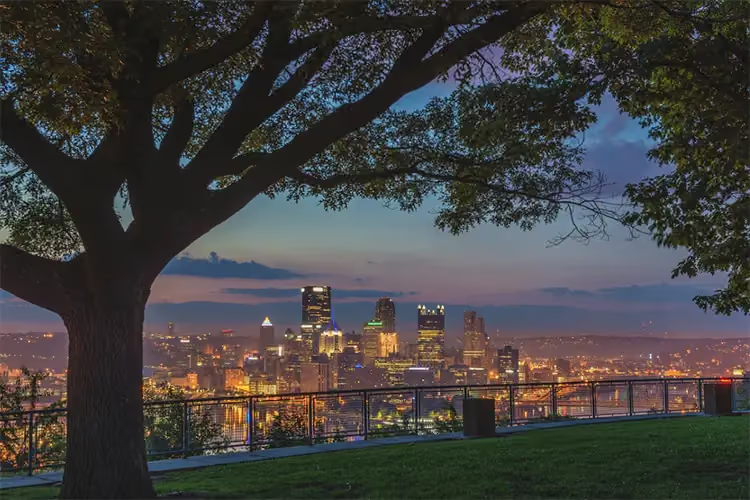

Main image courtesy of Pittsburgh Magazine.
I've told versions of this story in interviews for years. Pittsburgh Magazine told it beautifully. HuffPost got a piece of it. It appeared on Oprah's OWN network. My birth father Jimmy and I have talked about it publicly, laughed about it, been moved to tears by it in front of cameras and journalists and strangers who somehow became part of the telling.
But I've never written it myself, in full, on my own platform. That's always felt like an oversight and I'm fixing it now.
This is my story. All of it that I'm ready to share.
I was adopted. My parents -- Christine and Terry Maize -- were wonderful. I want to say that first and say it clearly, because the story of searching for birth parents is sometimes interpreted as a story about wanting different parents, and that was never true for me. I loved them. I love them still. My dad was a construction estimator who gave the best bear hugs. My mom survived cancer and continued to be a pillar of strength and well of inspiration in my life for many years. The family that raised me was real and whole and good.
But there's also a particular kind of incompleteness that comes with not knowing where you came from. It doesn't mean anything is wrong with your life. It just means there's a gap where a piece of your own story should be. You wonder who you look like. You wonder why you are the way you are. You wonder -- especially when you're a kid asking questions the adults around you can't answer -- whether you were wanted, whether there was something about you that made you leavable.
I sang before I talked and danced before I walked. There's a photo of me at three years old strumming a Smurfs guitar that ended up on the cover of one of my albums. I was theatrical, extroverted, driven in ways that were sometimes confusing to the people around me. My adoptive family were good, loving people, but they weren't particularly artistic. I didn't know where this side of me came from. It was just mine, floating without context.
At 21 I decided to look for my birth parents. My adoptive parents were supportive -- they'd always been honest with me about the adoption, and they wanted me to have whatever peace it might bring. But when I reached out to the attorney who had arranged my adoption, he told me a fire had destroyed the records. He told me I was setting myself up for failure. That it would be heartbreaking and expensive and I should let it go.
I let it go.
A few years later I joined an adoption support group. There was a woman there, a hardcore activist, who was skilled at finding records. She helped me locate information that led me to my birth mother in 2004. I was 24.
I called her. We were both emotional. She was kind. She told me I'd had a good upbringing and she seemed relieved by that. When I asked about my birth father, she said she didn't know much. We talked about meeting. And then, after a few months, she told me it was too hard. She needed to stop contact.
I was crushed. I understood -- I still understand -- how complicated it must be to carry that experience. Giving up a child is one of the bravest and most painful things a person can do, and the emotional weight of that conversation opening back up after 24 years must have been enormous. I hold her in my heart with compassion. But I was devastated.
Six months later, my dad died. Heart attack. He was a construction estimator, a generous man, a father who had given me everything he had. I watched him take his last breath. I cried at his feet for a week.
What I didn't know -- what I wouldn't know for years -- was that my dad had taken a secret to his grave.
My father's sister, my Aunt Gloria, had been involved in arranging my adoption. I had always had a feeling she knew more than she was telling me. I held a grudge against her for years -- quietly, the way you hold a grudge against someone you love, which is its own complicated thing.
One day I apologized to her for the grudge. She told me she'd been trying to protect me. And then she told me what she knew.
Twenty years after my birth and adoption, Aunt Gloria had run into an old friend — a nurse who had worked at the hospital where I was born. They had lunch. The nurse, casually and without apparent awareness of what she was sharing, referred to me as "the McNichol baby." She explained that my birth father was the pop icon.
My adoptive father Terry had found out. He had delayed telling me because I'd just been through the devastating experience with my birth mother, and he wanted to give me time. He was going to tell me. He never got the chance.
My then-boyfriend Joey -- now my husband -- is the one who finally surfaced it. During a visit with Aunt Gloria, out of nowhere, Joey asked her if she knew something about my birth father. He remembered she had let something slip years earlier about my birth father being a musician. When she heard the question, she looked as though she'd seen a ghost. And then she told us everything.
The sheer number of coincidences still astonishes me. A nurse having lunch with my aunt randomly, years after the birth. Joey remembering an offhand comment with his admittedly terrible memory. Me finally apologizing for a grudge I'd been carrying so my aunt felt safe enough to tell the truth.
What I've learned from this and from a lot of my spiritual practice is that the universe doesn't waste coincidences. Things arrive when they're supposed to arrive. Not when we want them to. When we're ready.
When I looked up Jimmy McNichol and watched footage of him, something clicked into place. This is why I am the way I am. The energy, the musicality, the performing in front of cameras since childhood -- I recognized it.
I was comfortable performing in front of hundreds of fans. I was terrified to dial this number.
I called. It went to voicemail. I hung up without leaving a message, relieved to have bought myself a little more time. A moment later my phone rang. He had seen the missed call and called back.
I introduced myself. I told him I was doing genealogical research. I asked if it was a good time to talk, if he was alone.
He said he was making lunch for the kids.
I said: I've been told I may be related to you. I've been told you may be my father. Is that possible?
There was a long pause.
Anything is possible.
I started talking. I told him I was a musician. I directed him to my videos. From 1,600 miles away in Colorado, he clicked a link and watched me rap and perform. He said later that the connection he felt was immediate and chemical, like pure magic. He knew it the second he saw me perform.
We agreed to DNA tests. Ten days after Jimmy got the results, he sent me a text.
Welcome to the family.
Jimmy McNichol was the Justin Bieber of his generation. In the late 1970s and early 80s, he and his sister Kristy McNichol were among the most recognizable young performers in America. He graced magazine covers, appeared in television movies and shows including California Fever and General Hospital, wrote his own music, and performed with a band that backed major artists including James Brown and Stephen Stills. Kristy McNichol was equally celebrated -- a two-time Emmy Award winner and one of the most beloved actresses of the era.
At 30, Jimmy walked away from Hollywood. Burnt out and ready for a quieter life, he built a ranch in Colorado with his wife Rene, raised two children -- Nash and Ellis -- became a real estate developer, an environmentalist, and a philanthropist. He was planning a comeback when I called him.
The synchronicities didn't stop at music. He was an environmentalist. He was an activist. He and Kristy had even developed an early show about ecological awareness that never got picked up -- too ahead of its time, before being green was mainstream. When I discovered this, I almost couldn't breathe. DNA really does play a role.
We agreed to meet in San Francisco. My adoptive mom Christine was supportive and terrified in equal measure — happy for me but scared I'd be hurt again, that he wouldn't show up, that it would end the way my birth mother had ended. She was my Momma Bear.
We both brought a close friend to help break the ice. Before long, the four of us were laughing.
He had never known I existed. He didn't remember signing any relinquishment papers. He had missed 36 years of my life. When I told him my story, he just said: Wow, this is cool.
That's very Jimmy.
I also got siblings. Jimmy's two children, Nash and Ellis, welcomed me immediately and completely. I had always wanted siblings. I found out I'm the oldest of five McNichol kids total. Nash spent a summer interning at my marketing company in Pittsburgh. Jimmy held my son Mateo for the first time, stood there staring at him in awe, and said I am a grandpa. It sounds so weird, but totally worth it. He was there for Mateo's first sunscreen application. Not the first word or the first step. The first sunscreen application. He videotaped it on his phone.
I had been so sad that my dad Terry died before he could become a grandfather. There was a hole in my heart that I didn't know how to describe. And then there was this man, this warm and exuberant and larger-than-life man who texted me things like I am in hog heaven right now and You are the best sister and called himself Pops and showed up ready to love all of us.
Aunt Kristy has been warm and generous. Having her in my life -- this woman who is such a significant figure in entertainment history -- is its own kind of surreal.
We appeared together on Oprah's OWN network show Where Are They Now in 2014. I used to dream as a kid about being on Oprah — imagining she would help me find my birth family the way she'd done for others. Instead, Jimmy and I appeared together, our story already resolved, two musicians who had found each other through a series of impossible coincidences and were figuring out what to do with the family they'd suddenly been handed.
I wrote about it for HuffPost before it aired -- a piece I've linked below. Watching myself write that piece now, I can feel how new it all still was. How careful I was with it. How much I was still absorbing.
The attorney who told me I was setting myself up for failure was wrong. The closed records that were supposedly destroyed didn't stop anything. The birth mother who ended contact before we could meet didn't close the door on my having a family. Every dead end turned out to be a detour.
I'm not promising everyone gets a Jimmy McNichol. I know that's not how this works. Searches end in disappointment and grief as often as they end in reunion, and the grief is real and valid and deserves to be held as carefully as the joy.
But I do believe the search itself is worth something. Not just for what you might find — but for what it teaches you about yourself and what you're willing to do to know where you came from. I was willing to make a call I was terrified to make. That willingness was its own kind of healing, regardless of what was on the other end of the line.
I also believe that family is larger than biology and larger than the family you were born into. The family that raised me was real. The family I found is real. They coexist without contradiction. There was a hole in my heart and it got filled — not because biology demands completion, but because love, when it shows up, tends to fill the available space.
A lot of journalists have told pieces of this story more gracefully than I've ever told it myself. I'm grateful to all of them.
The Pittsburgh Magazine piece by Cristina Rouvalis — Idol Find: Pittsburgh Rapper Teams Up with Dad Jimmy McNichol for New Show — remains one of the most thorough accounts of how the discovery unfolded. Cristina captured details I still forget to mention when I'm telling it in person.
My HuffPost piece, written right before the Oprah appearance — Creating Reality on Oprah: Finding My Famous Birth Dad and Aunt and Sharing the First Piece of Our Story — was my first public attempt to put it all into words.
The Oprah OWN segment — Where Are They Now, Jimmy McNichol — gives you Jimmy's perspective, which is different from mine and worth watching for that.
And a more recent interview with Steelers Takeaways — Exclusive with Pittsburgh Musician Kellee Maize — where I talk about the story as part of a broader conversation about my life and music.
Jimmy and I have talked for years about developing a television show called Finding Family: Search Angels — following adoptees searching for birth parents and documenting those stories with understanding and empathy, not exploitation. That project has been in various stages of development and conversation. I hope it happens. I think it would help people.
In the meantime, I'm here. I've built my life in Pittsburgh, made my music, raised my kids, found my practice, found my people, and found my father. All of that happened in the same city, across overlapping years, in a life that is stranger and richer and more full of impossible coincidences than I ever imagined when I was a kid pressing record on a cassette tape with my best friend, gluing our photo on the cover, not yet knowing any of what was coming.
It came anyway.
Don’t forget to follow Kellee for the latest news and music:
add soundcloud, IG





Sign up to get our latest news and stay connected.
Thank you! Your submission has been received!
Oops! Something went wrong while submitting the form